Firmware Engineering Has Its Own LeetCode. It Just Didn't Exist Until Now.
Although LeetCode and EWskills are completely different, I am comparing the only coding part of LeetCode vs EWskills (C & C++ Programming) and the mindset behind both platforms.
I have a lot of respect for what LeetCode has built. It's genuinely brilliant for what it does — it takes the patterns that show up in software engineering interviews and turns them into a repeatable practice system. If you want a job at a software company, LeetCode works. Thousands of engineers have proven that.
But here's the thing: I've interviewed hundreds of candidates for firmware roles. And the ones who've done nothing but LeetCode — they stand out. Not in a good way.
They can reverse a linked list easily. They can discuss time complexity. And they have no idea what volatile does, why you'd use a union to model a hardware register, or what happens when an 8-bit ADC reading of 180 maps to in volts.
That's not their fault. LeetCode never claimed to prepare them for this. The problem is that nobody told them clearly enough: firmware engineering is a different discipline, and it needs different practice.
This article is me saying that clearly.
What LeetCode is actually optimising for
LeetCode trains you to solve algorithmic problems efficiently, under time pressure, in a language-agnostic way. The problems are designed around:
- Data structures: arrays, trees, graphs, heaps, hashmaps
- Algorithm patterns: two pointers, sliding window, dynamic programming, BFS/DFS
- Time and space complexity: can you do this in O(n log n) rather than O(n²)?
This is exactly what software engineering interviews at companies like Google, Amazon, and Microsoft test. It's the right preparation for those roles, and it works because the underlying job involves building systems where algorithmic efficiency is a real constraint.
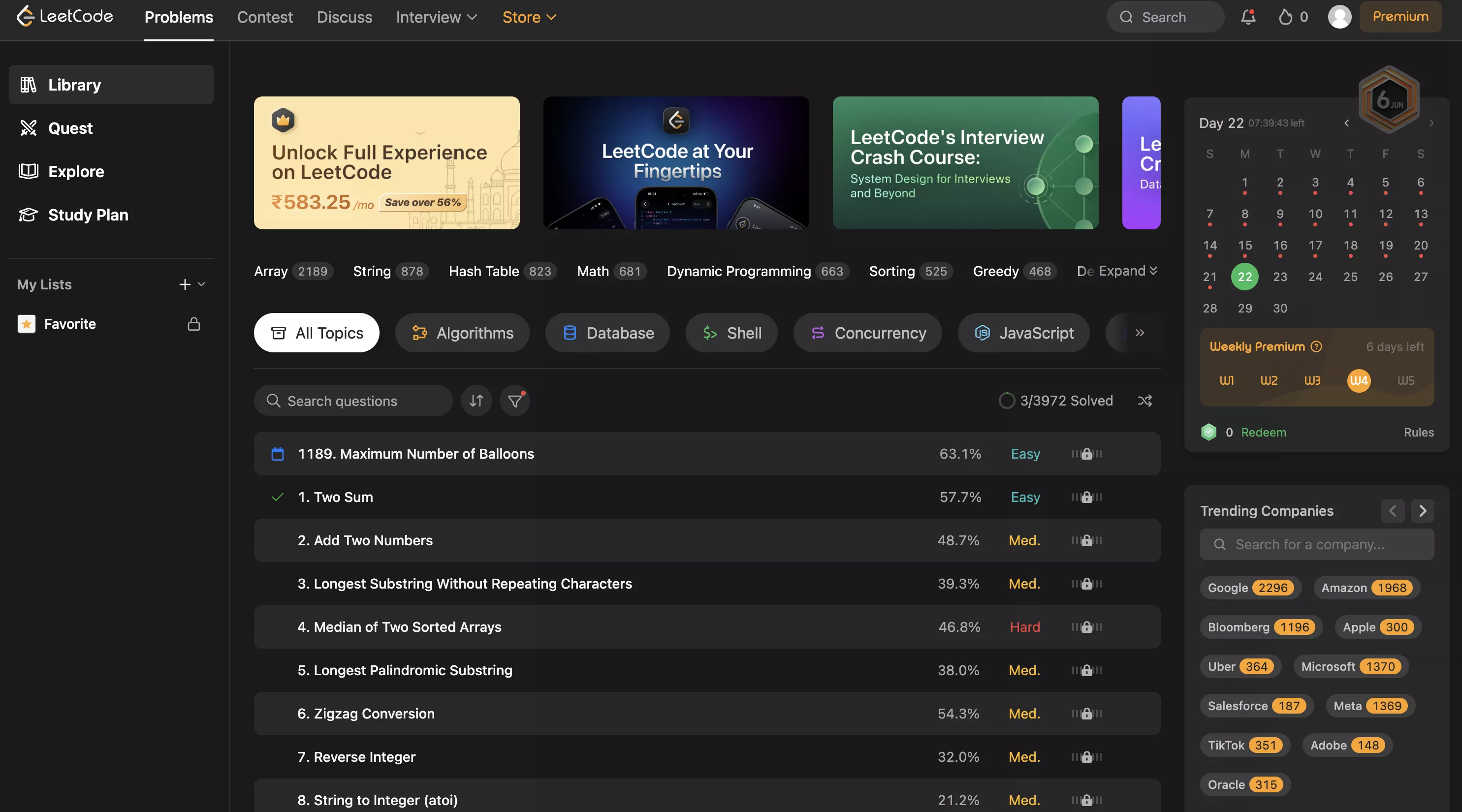
In software, you're running on a server or a laptop — GBs of RAM, GHz of CPU, a full operating system managing everything underneath you. The expensive operations are algorithm choices. Get those right, and you're in good shape.
What firmware engineering actually demands
Firmware is code that runs directly on a microcontroller. No operating system underneath. Often 2KB–256KB of RAM. CPU running at 8MHz to 240MHz. Every byte of Flash budget matters. Every cycle in a tight ISR matters.
The expensive operations aren't algorithm choices — they're hardware interface decisions. And the skills required to make those decisions have almost nothing to do with sorting algorithms or graph traversal.
Let me make this concrete. Here's what I test in a firmware interview, and here's what I've never once asked:
I always test:
- Bit manipulation —
REG |= (1 << 5)to set a bit,REG &= ~(1 << 5)to clear it. Not as trivia — as the actual way you configure hardware registers. - Pointer behaviour — void pointers, function pointers, pointer arithmetic, what happens when you cast a pointer to a register address. Real firmware is full of this.
volatile— why a hardware register variable must be declared volatile, what the compiler does if you don't, and why that silently breaks your code.- Struct and union layout — how to model a hardware register using a bitfield struct, how to use a union to view the same memory as a
uint32_tand a struct simultaneously. - Circular buffers — the standard pattern for UART receive buffers. Can you implement one?
- State machines — event-driven firmware. Can you model a device's operating states in code?
- Memory constraints — no
mallocin many bare-metal systems. How do you work without dynamic allocation?
I have never asked:
- How to reverse a linked list
- Binary tree traversal
- Dynamic programming
- Time complexity of sorting algorithms
These things don't show up in firmware. They're not the job.
The problem set tells the story
When we built EWskills, the question we asked wasn't "what does a practice platform look like?" The question was: "What does a firmware engineer actually do every day, and how do we turn that into graded practice?"
The answer is in the problems themselves. With a decade of experience in writing firmware for IoT, Industry automation, 8-bit, 32-bit controllers, Automotive, Biomedical applications, low-power applications, etc., we decided to create the problems that will mimic the firmware development.
Let me walk you through what the Embedded C and C++ tracks actually contain — because this is where the difference becomes completely clear.
Embedded C: what's in the track
The Embedded C track has 128 problems. Here's a sample of what you're actually solving:
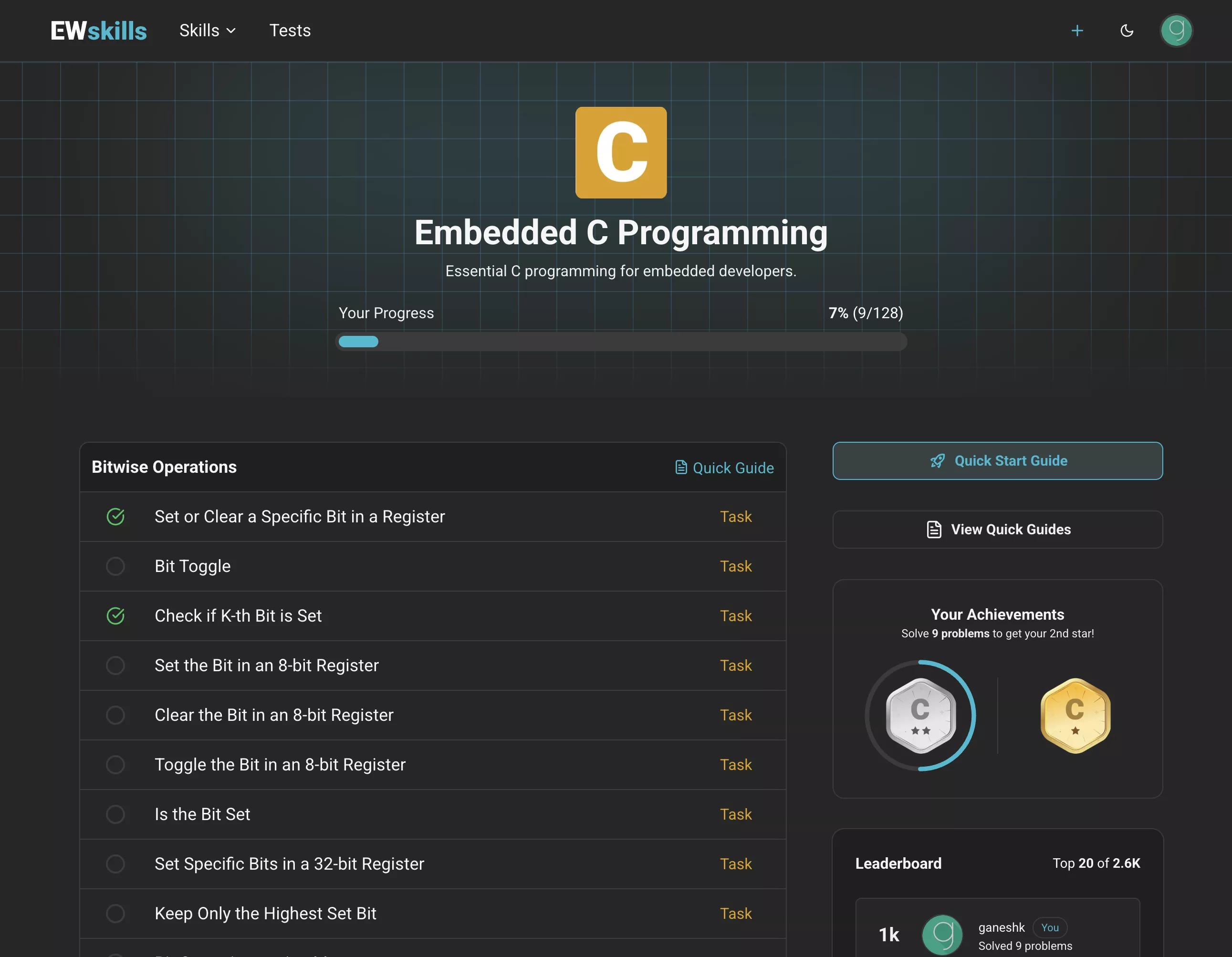
Set or Clear a Specific Bit in a Register. Not a bit in a general-purpose integer — a register. The problem mirrors the exact operation you perform when configuring a GPIO or timer peripheral.
Set Baud Rate Field in Control Register. You're given a control register layout and asked to pack a baud rate value into the correct bit field. This is what configuring a UART peripheral actually looks like at the register level.
Decode Status Register into Human-Readable Flags. A 16-bit status register, multiple flags packed in at different bit positions. Extract them. This is reading hardware state.
Macro-Based Register Config Helper. Write macros that make register operations readable. Every firmware codebase has these.
Control Register Using Nested Bitfields. Model a hardware register as a C struct with bitfields. Standard practice in any HAL.
Construct UART Data Frame with Parity Bit. Frame a byte for UART transmission — start bit, data bits, parity, stop bit. You're building the protocol, not just calling a library.
Circular Buffer Insert / Read / Peek. Three separate problems working through a circular buffer implementation from scratch. This is the UART receive buffer pattern used in almost every firmware project.
State Machine Using Function Pointers. Model states and transitions using a function pointer dispatch table. The standard pattern for event-driven firmware.
Transmit Float as Byte Stream Using Union. You need to send a float value over UART as raw bytes. How do you access the bytes? Union. This problem teaches you why.
Detect Underflow in Unsigned Subtraction / Signed vs Unsigned Comparison Traps. These arithmetic edge cases cause real firmware bugs. Silent, hard to debug, and specific to C at the hardware level.
On LeetCode, none of these exist, nether it focus on it. EWskills is built with a firmware mindset.
C++ for embedded: not general-purpose C++
The C++ track is 206 problems. But here's the thing — it's not teaching you generic C++. It's teaching you embedded C++. These are very different things.
General-purpose C++ teaches you to use new and delete, STL containers, exceptions, RTTI, and the full standard library. In embedded firmware, most of this is unavailable or dangerous. No heap allocator. No exceptions (they bloat binary size). No std::vector on a 16KB RAM system.
So the problems are specifically designed around what C++ can do in an embedded context:
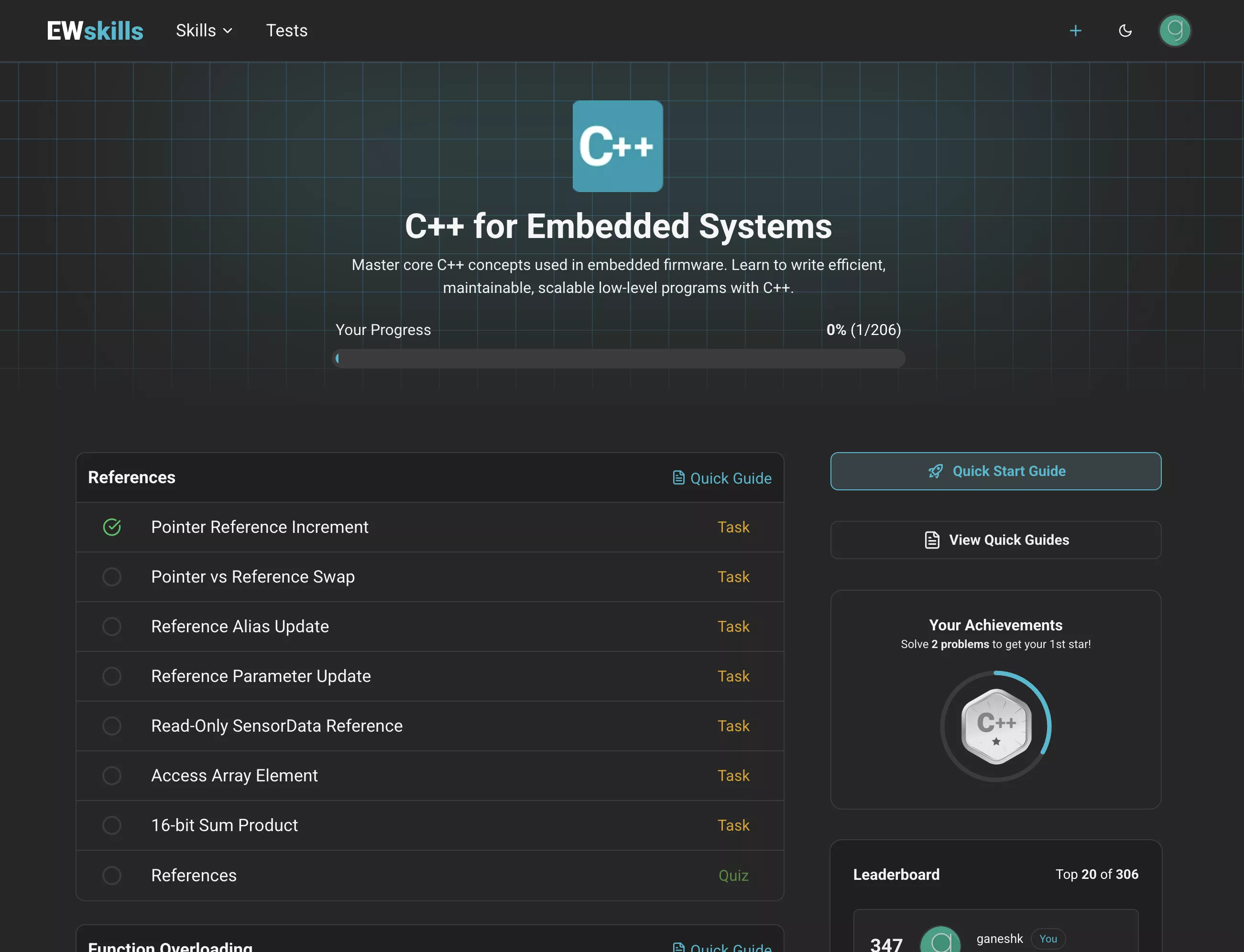
UART Initialization Defaults. Default function arguments to model hardware init with sensible fallbacks. Clean firmware interfaces.
GPIO Pin Toggle (inline). Inline functions for zero-overhead wrappers around register operations. The compiler eliminates the call overhead — important in tight loops.
Placement New with Static Buffer. Construct an object in a pre-allocated static buffer. The embedded alternative to heap allocation.
Timer Prescaler Configuration / UART Baud Rate Validation. C++ classes wrapping hardware peripherals — the hardware abstraction layer pattern.
Compile-Time ADC Voltage Scale / Constexpr ADC Temperature Table. Using constexpr to compute values at compile time. Zero runtime cost. The right way to handle lookup tables and conversion constants in firmware.
Validate Frame Size with static_assert. Catch structural errors at compile time. If your packet struct is the wrong size, the compiler tells you — not your customer.
GPIO State Enum / ADC Config Flags / State Machine with Enums. enum class for type-safe hardware states. No accidental integer-to-GPIO-state casting.
Non-Copyable UART Handle. Why a UART handle should never be copied — there's one UART peripheral, not two. The = delete pattern for resources that have hardware ownership.
Heap-Free Polymorphic Driver. Runtime polymorphism without dynamic allocation. The pattern you use when you want interface abstraction but can't use new.
Compile-Time Fixed Stack / Generic Moving Average Filter (templates). Zero-cost abstractions using templates. Type-safe, size-safe, no runtime overhead.
None of this is in a general C++ course. None of it appears on LeetCode. These are specifically the C++ patterns that appear in production firmware — and the patterns that get tested in interviews at automotive, IoT, and industrial embedded companies.
Software vs firmware: the mindset shift
Here's the sharpest way I can put it.
In software, you write code for a platform someone else built. The OS schedules your threads. The runtime manages your memory. The standard library handles the details. Your job is logic and architecture — build the right thing efficiently.
In firmware, you are the platform. You need hardware mindset. You initialise the hardware. You configure the clocks. You write the ISR that handles the interrupt. You decide whether there's a scheduler or not. You manage memory manually because there's no garbage collector, no OS heap manager, and sometimes no malloc at all. Your bugs don't crash a process — they corrupt hardware state, flatten batteries, or silently send wrong data for hours before anyone notices.
You have to write the firmware with absolute precision which should work for years without restart, without stuck. There is no margin for error.
The 1994 NASA Clementine mission failed when a firmware freeze caused thrusters to fire continuously, completely draining its fuel. Because the firmware team left the processor’s hardware watchdog timer unconfigured, millions of dollars were lost.
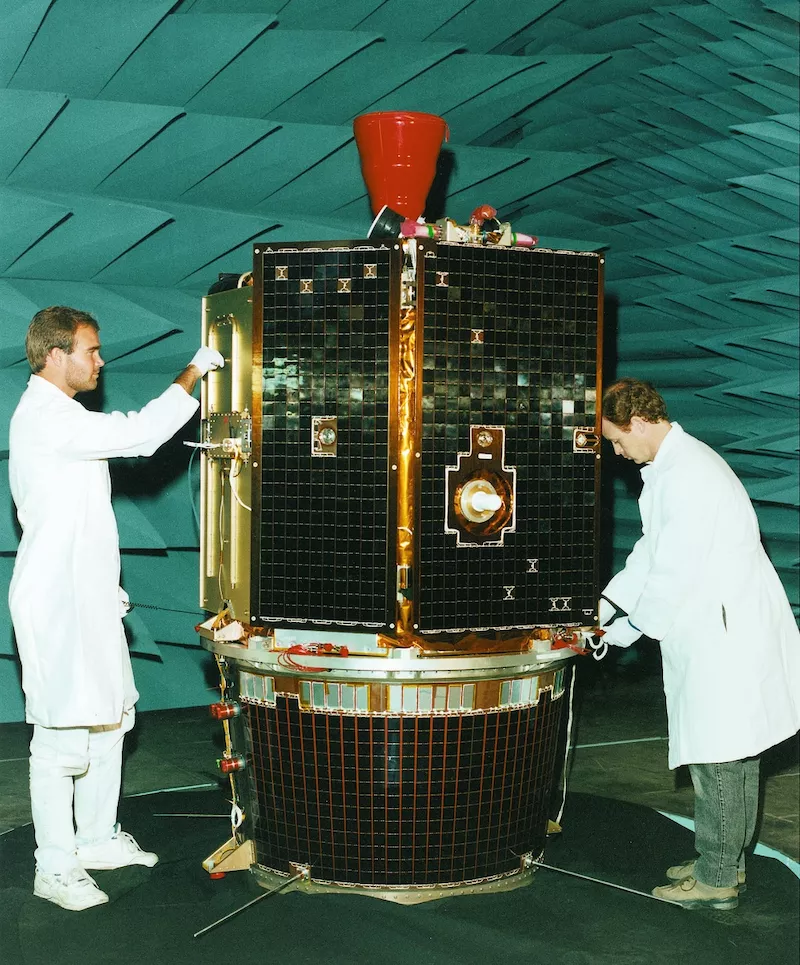
Whether it is Automotive or Biomedical, there is no margin for error in the firmware development.
The tools are different. The constraints are different. The failure modes are different.
Practicing for firmware by doing LeetCode is like training for a marathon by swimming. Both are good for fitness. They don't transfer the way you need them to.
What EWskills is
EWskills (ewskills.com) is a browser-based practice platform built specifically for electronics engineers. 636 problems and counting across skill tracks — Embedded C, C++ for Embedded Systems, Mastering Microcontrollers, Verilog, Component Skills, and Circuit Protection. Every problem runs in the browser, gets validated automatically, and is built around decisions a real firmware engineer makes on the job.
If LeetCode is the benchmark for software engineers, EWskills is what we're building for electronics engineers.
Key Takeaways
- LeetCode trains algorithms and data structures — the right preparation for software engineering roles at CS companies. Not for firmware.
- EWskills Embedded C and C++ are developed with a firmware development mindset.
- Firmware interviews test hardware-aware C: bit manipulation, register operations, volatile, pointers, struct/union layout, circular buffers, state machines.
- The EWskills Embedded C track has 128 problems built specifically around firmware patterns — register config, UART framing, circular buffers, union overlays, and arithmetic traps.
- The EWskills C++ track is not general C++ — it's embedded C++: placement new, constexpr, static_assert, RAII, non-copyable handles, heap-free polymorphism.
- Practicing the wrong thing builds false confidence. The gap only shows up when you're in the interview room.
FAQ
Q: Can LeetCode help at all for firmware interviews?
Some companies with large software engineering orgs ask LeetCode-style questions for embedded Linux or systems programming. Although the possibility is low.
But pure firmware roles at IoT, automotive, and industrial companies almost never do. Know which type of role you're applying for. When in doubt, check the job description: if it says "bare metal", "RTOS", "register-level", or "microcontroller", prepare for firmware, not algorithms.
Q: I already know C basics. Where should I start on EWskills?
Start with the Embedded C track — specifically Bitwise Operations and Bit Field Operations. These are the most common interview topics and the foundation everything else builds on. If you can't set and clear specific bits in a register without thinking, that's the gap to close first.
Q: Is C++ necessary for embedded roles?
For most entry-level and mid-level firmware roles: not immediately required, but increasingly expected. More companies — especially in IoT, automotive, and medical — are moving their codebases to C++ for scalability, maintaining, etc. Even whole Arduino framework is based on C++. Getting comfortable with embedded C++ after your C fundamentals are solid is the right career move. The EWskills C++ track is specifically designed for that progression.
| Written by- | |
 | Ganesh Khomane (Co-Founder EWskills) |