Why Firmware Developers Need to Master C++ (Not Just Learn C)
Most firmware developers learn C. Then they stop.
They program in C. They debug in C. They feel it's enough.
It was enough. Ten years ago.
Firmware has changed since then. Products have more features. More peripherals. More engineers touching the same code. C alone struggles to hold that together cleanly.
C++ is not a replacement for C. Think of it as an upgrade in how you organise firmware. You keep the same control over hardware. You get better tools to manage complexity.
If you know C well, learning C++ is not optional anymore. It's the next skill on your path.
What Changes When Firmware Gets Bigger
Small firmware is easy in C. One file. One loop. A few functions.
Real products aren't like that.
An IoT device today has multiple sensors, a communication stack, a state machine, and often three or four hardware variants sharing one codebase. C manages this through convention — naming patterns, function pointers, structs pretending to be objects. It works. Until someone new joins the team. Or a deadline gets tight. Then the convention breaks.
I've reviewed firmware where the same "object" pattern was built four different ways in one codebase. Not because the engineers were careless. Because C gives you no way to enforce structure. C++ does.
Five Reasons C++ Matters for Firmware
- It organises growing complexity.
Classes group a peripheral's state and behaviour into one unit. A UART driver becomes an object with a clear interface — not five functions that all quietly depend on the same global buffer. - It catches mistakes before you flash the board.
enum classstops you from comparing a motor state to a baud rate by accident.constexprandstatic_assertmove checks to compile time. A bad buffer size fails your build, not your product in the field. - It gives you real control over memory.
RAII ties cleanup to object lifetime. A peripheral initialises in a constructor and releases in a destructor. No "forgot to call cleanup" bugs. Use static memory instead of the heap, and you get this control with zero risk. - It costs nothing at runtime, if you use it right.
This is the part sceptics get wrong. Modern C++ — C++11 and later — was built around zero-cost abstractions. Features likeconstexprand RAII cost nothing at runtime when used correctly. Skip exceptions, skip RTTI, skip uncontrolled heap use, and your compiled code performs like C. Because it compiles to the same machine instructions. - It's where the industry is heading.
C++ still sits in the top five languages worldwide as of early 2026. Automotive and medical firmware increasingly build against standards like AUTOSAR C++14 and MISRA C++, specifically because they need structure without losing real-time performance. If your career touches automotive, medical, or any regulated product, this isn't a "nice to know" anymore. It's in the job description already.
Where C++ Already Runs, Whether You've Noticed or Not
Here's proof this isn't theory. Some of the biggest names in embedded development already run on C++. You may be using one right now without realising it.
- Arduino. The entire framework is C++. Every .ino file you write compiles as C++. Beginners write "C-style" code for years without knowing they're already calling into a C++ class.
- ESP-IDF (ESP32). Espressif's official SDK supports both C and C++. Newer components ship with C++ wrappers.
- Zephyr RTOS. The kernel is written in C, but Zephyr officially supports building applications in C++. It runs on over 1,000 boards and is backed by Intel, Nordic, NXP, and ST — this is not a niche RTOS.
- nRF Connect SDK (Nordic) — built on Zephyr, inherits Zephyr's C++ support.
- FreeRTOS — kernel is C, but application/task code is commonly written in C++ on top of it
- AUTOSAR Adaptive Platform. The automotive industry's software standard for next-generation vehicles is built on C++14. Classic AUTOSAR was C. Adaptive is C++, because the systems got too complex for C alone- the same reason this article exists.
- ROS 2 (Robot Operating System). The primary client library engineers use to write robotics firmware, rclcpp, is C++ first.
- Qt for embedded Linux. Dashboards, industrial control panels, medical device screens, and embedded GUIs use C++.
- TensorFlow Lite Micro — the inference runtime itself is written in C++.
- Edge Impulse SDK — C++-based inference library for on-device ML.
Where C++ Still Goes Wrong
I won't pretend the risks disappeared.
Exceptions still add overhead most real-time loops can't afford. RTTI still bloats your binary. Templates, used carelessly, can explode your code size fast. Deep inheritance for a simple GPIO driver is a solution nobody asked for.
None of this means avoid C++. It means use a smaller, deliberate part of it. The same way disciplined C code avoids malloc() inside a main loop.
Embedded C++ is not general C++ dropped onto a microcontroller. It's C++ with the runtime-cost features turned off, and the structure and safety features turned on.
How to Actually Learn Embedded C++
Most C++ courses teach you new and delete, STL containers, exceptions, the full standard library. None of that works on a microcontroller with 16KB of RAM. No heap allocator. No exceptions — they bloat your binary. No std::vector when you're counting bytes. You finish the course knowing syntax you can't safely use on real hardware.
That's the gap the C++ for Embedded Systems track on EWskills was built to close. Not general C++. Embedded C++.
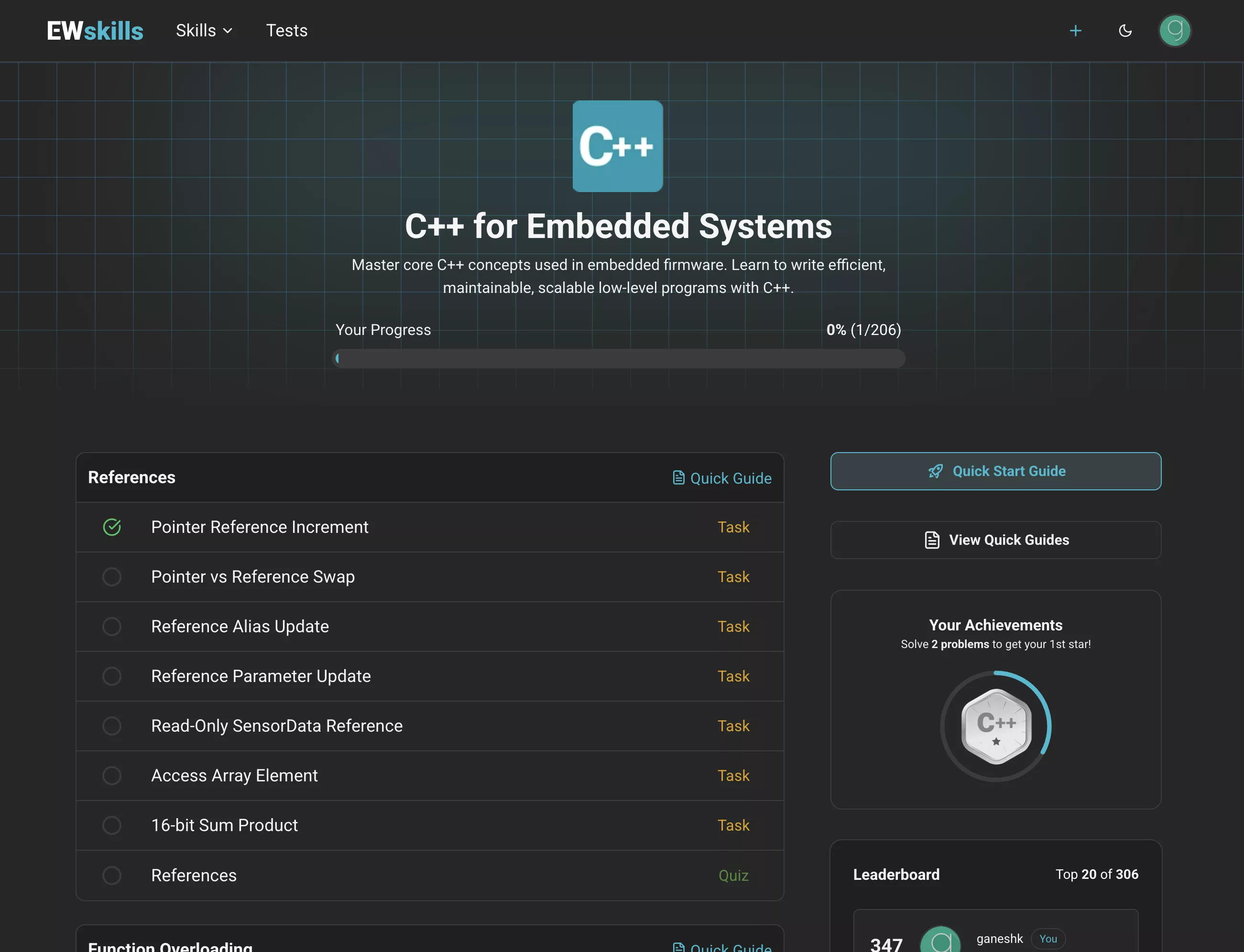
Here's the mindset behind the problems. Every one of them mirrors a decision you'd actually make writing firmware
- UART Initialisation Defaults — using default function arguments to model hardware init with sensible fallbacks.
- GPIO Pin Toggle (inline) — inline functions as zero-overhead wrappers around register operations, the compiler removing the call cost entirely.
- Placement New with Static Buffer — constructing an object in a pre-allocated static buffer, the embedded alternative to heap allocation.
- Constexpr ADC Voltage Scale — computing conversion values at compile time, not runtime. Zero cost, the right way to handle lookup tables in firmware.
- Validate Frame Size with static_assert — catching a wrong packet struct size at compile time, before it ever reaches a customer.
- Non-Copyable UART Handle — understanding why a UART handle should never be copied. There's one UART peripheral, not two.
- Heap-Free Polymorphic Driver — runtime polymorphism without new. The pattern you reach for when you want interface abstraction but can't touch the heap.
None of this shows up in a generic C++ course. None of it shows up on a typical coding practice site either. These are the exact patterns that turn up in production firmware, and the same patterns interviewers at automotive, IoT, and industrial companies actually test for.
Every problem runs and validates in your browser.
One thing before you start: this track assumes you already know C well. It's not where you learn to program. It's where you learn to think differently, in a language you already write.
The Real Point
Firmware is getting bigger, and the engineers who stop at C are the ones who feel behind when their team moves to C++, or when a job posting lists it as a requirement they can't check off.
Mastering C++ for firmware isn't about chasing a trend. It's about not getting stuck.
Key Takeaways
- Most firmware developers stop at C because it's familiar — not because C++ has stopped being useful for firmware.
- Modern firmware has outgrown what plain C can structure through convention alone; C++ enforces that structure natively.
- Used correctly (no exceptions, no RTTI, static memory), modern C++ runs at the same performance as C.
- Automotive and medical firmware are standardising on C++ (AUTOSAR C++14, MISRA C++), making it a career requirement in those domains.
- Generic C++ courses don't transfer to firmware; targeted embedded practice, like the EWskills C++ for Embedded Systems track, closes the actual gap.
FAQ
Is C++ slower than C for embedded systems?
No, not if you use it correctly. Avoid dynamic allocation, exceptions, and RTTI, and stick to static memory. The compiled output performs the same as equivalent C code.
Should I learn C++ before Embedded C?
No. Learn Embedded C first. Embedded C++ assumes you're already comfortable with pointers, structs, and memory basics. It teaches you to apply C++ features to problems you already understand at the C level.
Do I need C++ if I only work on small microcontroller projects?
Maybe not right away. But most firmware careers eventually touch bigger codebases, IoT products, or regulated industries where C++ is expected. Learning it early keeps you ahead, not catching up.
| Written by- | |
 | Ganesh Khomane (Co-Founder EWskills) |