47. Power Slide Switch Selection
1. Component Purpose
A slide switch provides simple manual ON/OFF power control for a battery-powered device. The user slides the actuator to one position to turn power ON, and to the other to turn it OFF.
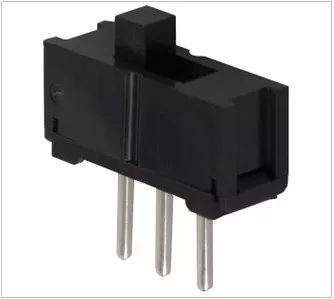
An SPDT (Single Pole, Double Throw) slide switch has three pins: one common and two positions. The common pin connects to one position or the other depending on the slider position. For power control, one position connects the battery to the circuit (ON), and the other disconnects it (OFF).
Required: SPDT · On-On · ≥200mA · ≥12VDC · Through Hole · PC Pin
2. How to Find It on DigiKey
Go to DigiKey.com → Switches → Slide Switches
Apply these filters:
- Circuit → SPDT
- Switch Function → On-On
- Current Rating (Amps) → 200mA or higher
- Voltage Rating - DC → 12V or higher
- Mounting Type → Through Hole
- Termination Style → PC Pin
- Part Status → Active
Tip: Some slide switches are rated for AC only. Make sure the datasheet confirms a DC voltage and current rating, since this is a DC-powered device.
3. Key Specifications & What They Mean
| Specification | Required | Why |
|---|---|---|
| Circuit | SPDT | One common, two positions for ON/OFF. |
| Switch Function | On-On | Latching in both positions. |
| Current Rating | ≥200mA | Device draws 150mA; margin needed. |
| Voltage Rating | ≥12VDC | Must handle 12V DC supply. |
| Actuator Length | 1.5–3.0mm | Enough to slide comfortably. |
| Switch Travel | 2.0–3.0mm | Clear tactile travel between positions. |
| Operating Force | 150–300gf | Firm enough to avoid accidental toggling. |
| Mounting | Through Hole, PC Pin | PCB-mounted. |
| Temp Range | −20°C to +70°C | Standard for enclosed consumer devices. |
4. Selecting a Safe, Production-Ready Part
The filtered list will show matching parts. Before you pick one, check: Is it Active? Is stock available? Is the manufacturer reputable? Is a datasheet available?
Full checklist: How to Select a Safe, Production-Ready Component — EWskills Guide
5. Filtered DigiKey Link
➡ View Matching Parts — Slide, SPDT, On-On, ≥200mA, ≥12VDC, Through Hole