19. MOV Protection & Failures
Question.5
A 230VAC surge protection circuit uses a MOV across L-N — but no fuse is installed upstream.
The MOV works correctly for 3 years, absorbing small surges.
Eventually the MOV degrades and fails short circuit.
What happens next?
What is a MOV?
A Metal Oxide Varistor (MOV) is a surge-protection component
- At normal voltages → it behaves like an insulator (very high resistance).
- At surge voltages (spikes, lightning, ESD) → it suddenly becomes a conductor, clamping the voltage to a safe level.
Think of it as a “voltage safety valve” in your circuit.
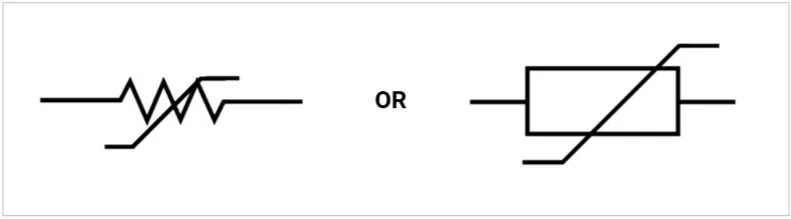
Schematic Symbols:
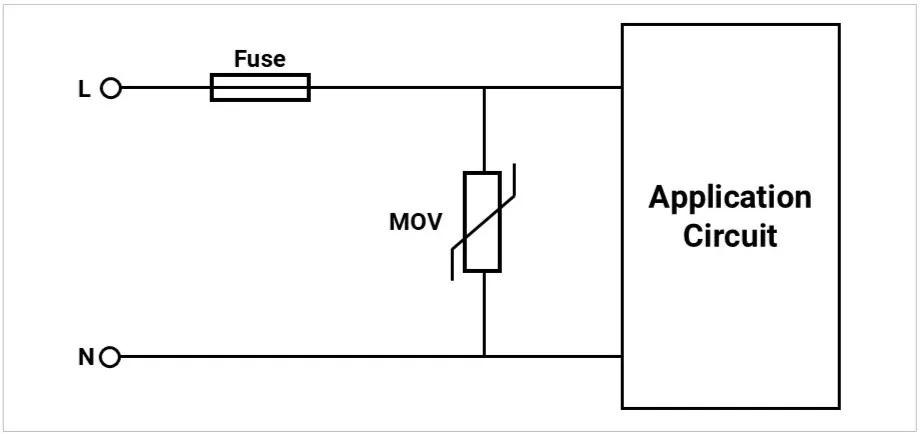
Simple MOV circuit diagram:
Working Principle
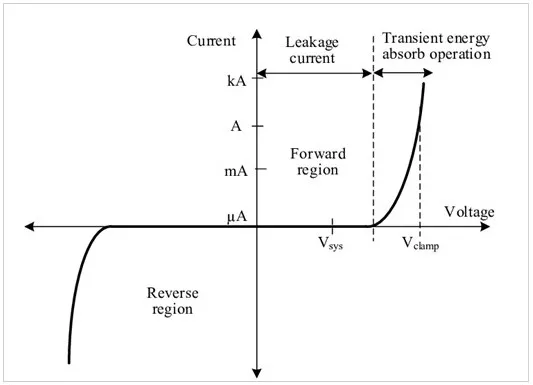
- At low voltages, very little current flows (high resistance).
- When the voltage exceeds a threshold (varistor voltage), the barrier breaks down → MOV conducts heavily → clamps the surge.
- After the surge, MOV returns to a high resistance state.
V-I Characteristics of a TVS Diode:
Practical Use Cases
- Surge protectors and power strips (AC mains).
- Switching power supplies (SMPS).
- Automotive (handling load dumps, jump starts, spikes).
- EV chargers and inverters (protecting power electronics).
- Telecom/Ethernet lines (low-capacitance MOVs).
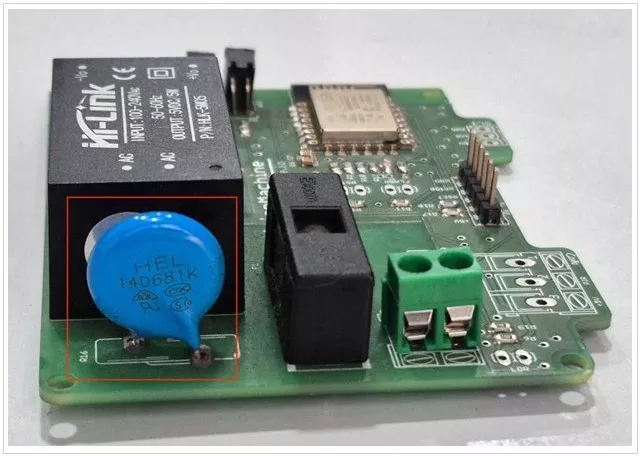
MOV used in Power Line
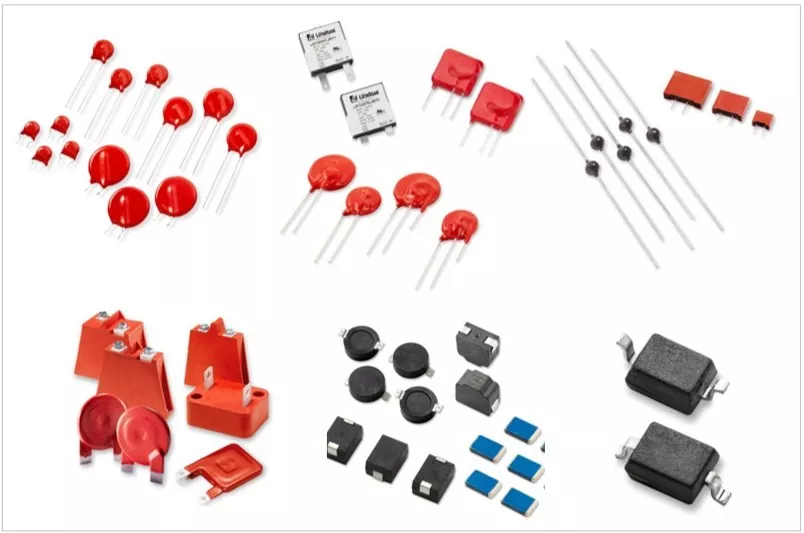
Types of MOVs
| Type | Image | Description |
|---|---|---|
| Radial Leaded | 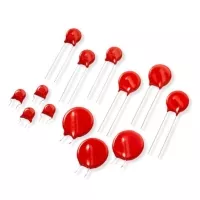 | Used for general surge protection in power supplies and electronic circuits. |
| Surface Mount (SMD) | 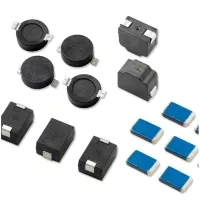 | Used for compact surge protection in consumer electronics and dense circuits. |
| Thermally protected (TMOV) | 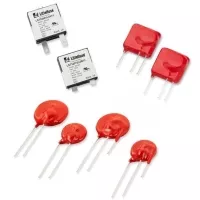 | Used in UPS, inverters, and power strips for safe protection with thermal cutoff. |
| Industrial High-Energy Block | 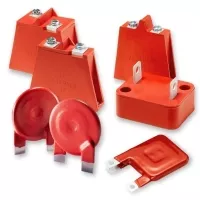 | Used in power lines and outdoor/industrial equipment for handling high surges. |
| Axial Leaded | 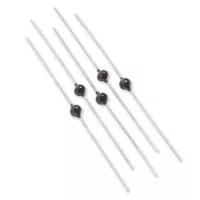 | Used for low-energy surge protection in signal lines and small circuits |
Key Specifications
- MCOV (Max Continuous Operating Voltage)
- Highest AC/DC voltage the MOV can handle continuously.
- Choose ~20–30% above normal operating voltage.
- Varistor Voltage (V1mA)
- Voltage where the MOV starts conducting (at 1 mA).
- Clamping Voltage (Vc)
- Maximum voltage during a surge.
- Must be lower than the circuit’s safe limit.
- Maximum Surge Current (Imax)
- Peak surge current (8/20 µs waveform) the MOV can withstand.
- Energy Rating (Joules)
- Energy the MOV can absorb in a single surge event.
- Response Time
- Very fast (nanoseconds), but slower than TVS diodes.
- Capacitance
- Acts like a capacitor → high values can affect high-speed signals.
- Leakage Current
- Small current flows even in normal operation; it increases with aging.
- Endurance / Lifetime
- Degrades with each surge → voltage drops, leakage rises over time.
Example Littelfuse TMOV Series MOV Specifications:
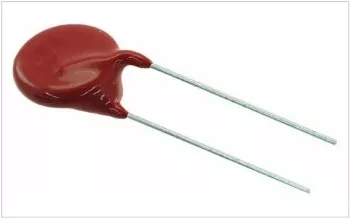
| Specification | Value for TMOV14RP150E |
|---|---|
| Maximum Continuous Operating Voltage (MCOV) | 150 VAC 200 VDC |
| Varistor Voltage (V1mA) | 240 V (Nominal) 216 V (Min) – 264 V (Max) |
| Clamping Voltage (Vc) | 395 V |
| Maximum Surge Current (Imax) | 6,000 A (1 pulse) 4,500 A (2 pulses) |
| Energy Rating (Wtm) | 60 Joules |
| Capacitance | 800 pF (Typical) |
| Operating Temperature | -55°C to +85°C |
| Leakage Current | Microamp range |
| Thermal Protection | Integrated Thermal Element |
MOV Usage in Circuits
- Across AC mains: Line-to-neutral, Line-to-ground.
- Across DC power rails: 12V, 24V, 48V systems.
- With fuses: MOV + fuse = safe failure mode.
- With TVS diode: TVS for precision spikes, MOV for bulk energy.
Application Examples
- AC Power Line Protection: Used across line–neutral in power supplies, adapters, and SMPS to protect against voltage spikes and surges.
- Surge Protection Devices (SPD): Widely used in power strips and surge protectors to clamp lightning and switching transients.
- Power Distribution Systems: Installed in substations and electrical panels to safeguard equipment from lightning surges and grid faults.
- Consumer Electronics: Found in TVs, computers, chargers, and home appliances as a first line of surge protection.
Limitations of MOVs
- Gradual Degradation: Every surge hit causes microscopic internal damage, meaning it has a limited lifetime and is not an infinite protection device.
- Low Precision Clamping: It cannot clamp voltage very precisely, making it ideal for rugged power circuits but unsuitable for precise IC-level protection.
- Short-Circuit Failure: Since an MOV can fail in a short-circuit state, you must always use a fuse in series to prevent fire or board damage.
- High Capacitance: The inherent internal capacitance is high ($200$–$1000$ pF), which can distort or "swallow" high-speed digital signals.
- Thermal Runaway Risk: Sustained overvoltage can cause the device to overheat and potentially catch fire without a thermal disconnect.
Design Considerations
When designing with a Metal Oxide Varistor (MOV), you must evaluate specific electrical parameters to ensure the device protects the circuit without failing prematurely.
- Operating Voltage Selection: Choose a Varistor Voltage (VRMS) that is at least 20% to 30% higher than your standard line voltage to avoid accidental triggering during minor fluctuations.
- Joule Rating (Energy Absorption): Ensure the MOV is rated to handle the maximum expected transient energy (measured in Joules) to prevent the component from exploding during a major surge.
- Clamping Voltage Level: Select a device with a clamping voltage low enough to protect your sensitive downstream components, but high enough to prevent constant conduction.
- Placement for Safety: Always place a fuse in series before the MOV to prevent a fire if the device fails in a short-circuit state.
- Capacitance Awareness: Avoid using standard MOVs on high-speed data lines, as their high parasitic capacitance (– pF) will distort or "swallow" the digital signal.
- Lead Length Minimization: Keep PCB traces and component leads as short as possible to reduce parasitic inductance, which can slow down the MOV's response time during a fast spike.
Comparison with Other Devices
Feature | TVS Diode | MOV (Metal Oxide Varistor) | GDT (Gas Discharge Tube) |
|---|---|---|---|
Image | 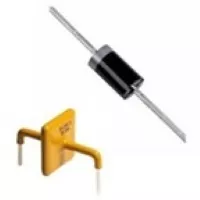 | 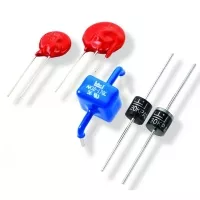 | 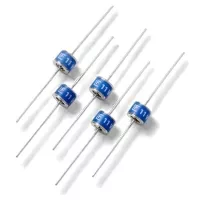 |
Response Speed | Ultra-fast (<1 ns) → ESD & fast spikes | Fast (100 ns – µs) → mains surges | Slow (µs–ms) → lightning surges |
Clamping Precision | Very precise (protects 3.3 V, 5 V, 12 V ICs) | Moderate (hundreds of volts range) | Poor (fires at 75–600 V, not exact) |
Energy Handling | Low (Watts level) | Medium–High (tens–thousands of Joules) | Very High (kiloamp lightning strikes) |
Best Application | IC-level, USB, HDMI, RS-485, automotive pins | AC mains, SMPS, automotive load dump | Telecom lines, outdoor gear, power grids |
Lifetime | Good for repeated ESD | Degrades after multiple surges (aging) | Very durable for big surges, but slow |