
55. MUX Tree using Loops
Build an 8-to-1 multiplexer using a 3-level tree of 2:1 muxes. Drive each level with one bit of sel, from LSB to MSB. Implement as a tree using a single always @* with for loops (constant bounds).
Requirements
- Module:
mux8_tree - Inputs:
d[7:0],sel[2:0] - Output:
y
Behavior
- Inputs:
d[7:0](eight 1-bit inputs) - Select:
sel[2:0](binary index 0–7) - Output:
y = d[sel]
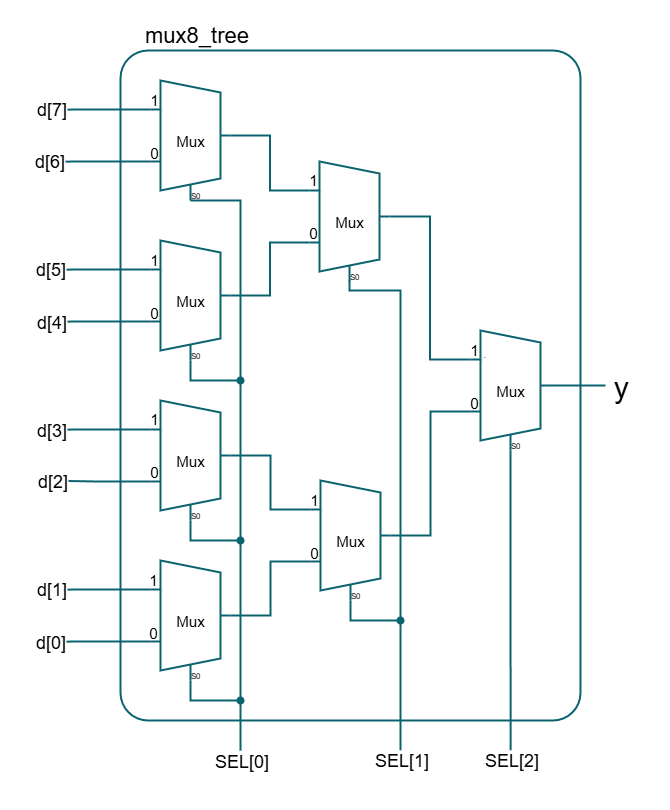
Need Help? Refer to the Quick Guide below
If-Else Statement
Syntax:
if (expression)
   statement;
else if (expression)
   statement;
else
   statement;
Key Rules
expressionmust evaluate to a 1-bit result (0,1,x,z).- Execution is first true branch wins (checked top to bottom).
- If none match and no
else, no action occurs.
Common Uses
- Combinational decision making inside
always @(*). - Priority logic (highest branch gets priority).
Guidelines
- Always use full coverage (
elseordefault) to avoid unintended latch inference. - Use
begin…endfor multiple statements. - Use
casefor parallel decisions;if-elseis better for priority logic.
Example
always @(*) begin
  if (sel == 2'b00)     y = a;
  else if (sel == 2'b01) y = b;
  else if (sel == 2'b10) y = c;
  else                   y = d; // avoids latch
end
Case, Casez, Casex Statements
General Syntax:
case (expression)
   value1: statement;
   value2: statement;
   ...
   default: statement;
endcase
Case
- Exact match (bit-by-bit, including
x/z). - Good for one-hot encoding or multi-way decode.
Casez
- Treats Z and ? as don’t-cares.
- Useful for partial matches and encoders.
casez (opcode)
   4'b1???: alu_op = ADD;
   4'b01??: alu_op = SUB;
   default: alu_op = NOP;
endcase
Casex
- Treats X, Z, and ? as don’t-cares.
- Risky → can mask real unknowns in simulation.
- Synthesis tools may treat it differently; use sparingly.
Guidelines
- Always include
defaultto prevent latches. casezis preferred overcasexin synthesizable RTL.- Case statements are parallel (not priority) unless overlapping values are used.
For Loop Statement
Syntax:
for (init; condition; step) statement;
Rules
- All loop control variables must be declared (
integer i;). - Loop unrolls during elaboration if bounds are static.
- Synthesizable only with constant bounds.
Example
integer i;
always @(*) begin
  sum = 0;
  for (i=0; i<8; i=i+1) begin
    sum = sum + data[i];
  end
end
Guidelines
- Use
forloops to describe repeated hardware structures (not like software loops). - Avoid unbounded or runtime-dependent loops in RTL → not synthesizable.
- For simulation-only,
foreverandwhileare also allowed.