73. PNP Transistor for Sensor Module Power Control
1. Component Purpose
In a battery-powered IoT device, turning OFF unused peripherals during sleep mode can dramatically extend battery life. A PNP transistor as a high-side switch on the 5V rail lets the MCU completely disconnect power to the sensor module.
When the MCU drives the PNP base LOW (through a resistor), current flows from emitter to base, turning the transistor ON and supplying 5V to the sensor. When the base is HIGH, the transistor turns OFF and the sensor draws zero current.
A PNP is used (instead of NPN) because it switches on the high side — between the 5V supply and the load. The emitter connects to 5V, and the collector feeds the sensor module.
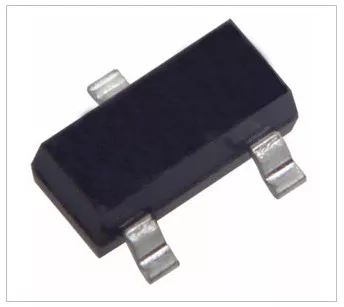
Required: PNP · Ic ≥200mA · Vceo ≥20V · hFE ≥80 · Vce(sat) ≤400mV · ≥200mW · SOT-23 · SMD
2. How to Find It on DigiKey
Go to DigiKey.com → Discrete Semiconductor Products → Transistors - Bipolar (BJT) - Single
Apply these filters:
- Transistor Type → PNP
- Current - Collector (Ic) (Max) → 200mA or higher
- Voltage - Collector Emitter Breakdown (Max) → 20V or higher
- DC Current Gain (hFE) (Min) → 80 or higher
- Vce Saturation (Max) → 400mV or lower
- Package / Case → SOT-23-3 (TO-236)
- Part Status → Active
Tip: For battery-powered designs, check the transistor’s base-emitter leakage current. Even when OFF, a small leakage current flows. For most SOT-23 PNP transistors this is negligible (nanoamps), but verify in the datasheet if ultra-low power matters.
3. Key Specifications & What They Mean
| Specification | Required | Why |
|---|---|---|
| Transistor Type | PNP | High-side switch; emitter to 5V, collector to load. |
| Ic (Max) | ≥200mA | Sensor draws 50mA; ~4× margin. |
| Vceo (Max) | ≥20V | Operates on 5V rail; generous margin. |
| hFE (Min) | ≥80 | Ensures saturation with small base current. |
| Vce(sat) | ≤400mV | Low drop preserves sensor supply voltage. |
| Power | ≥200mW | Actual dissipation: 0.4V × 50mA = 20mW. |
| Package | SOT-23-3 | Compact for IoT board layout. |
| Temp Range | −40°C to +125°C | Industrial conditions. |
| RoHS | Yes | Compliance required. |
4. Selecting a Safe, Production-Ready Part
The filtered list will show matching parts. Before you pick one, check: Is it Active? Is stock available? Is the manufacturer reputable? Is a datasheet available?
Full checklist: How to Select a Safe, Production-Ready Component — EWskills Guide
5. Filtered DigiKey Link
➡ View Matching Parts — PNP, SOT-23, Ic≥200mA, Vceo≥20V, hFE≥80