
7. Ceramic Cartridge Fuse for Industrial Equipment
1. Component Purpose
The industrial control panel runs on 230VAC mains. If a short circuit or component failure occurs, fault current can reach hundreds of amps. Without a fuse, this can cause fire, arc flash, or catastrophic damage to the panel.
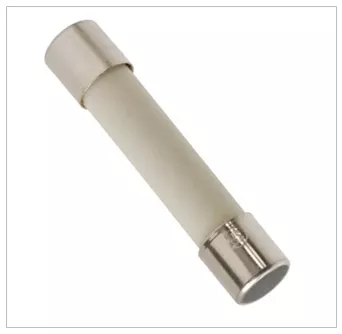
A ceramic cartridge fuse is used instead of glass because ceramic bodies have much better arc containment at mains voltages. If the fuse blows on a high-energy fault, the ceramic body safely contains the arc inside.
A medium/slow blow response is needed because mains-connected equipment draws a brief inrush current at power-on (e.g., transformer magnetizing current, capacitor charging). A fast-blow fuse would trip on every power-on.
Required: Ceramic Cartridge · 5A–6A · ≥250VAC · Medium/Slow Blow · 5mm × 20mm · Breaking Capacity ≥200A · Littelfuse · RoHS
2. How to Find It on DigiKey
Go to DigiKey.com → Circuit Protection → Fuses
Apply these filters:
- Fuse Type → Cartridge, Ceramic
- Current Rating (Amps) → 5A or 6A
- Voltage Rating - AC → 250V or higher
- Response Time → Medium Blow or Slow Blow
- Package / Case → 5mm x 20mm
- Manufacturer → Littelfuse Inc.
- Part Status → Active
Why 5A–6A and not 4A? The panel draws up to 4A. The fuse rating should be above the normal operating current to avoid nuisance blowing. Applying the standard 75% derating rule: 4A ÷ 0.75 = 5.3A. The nearest standard fuse values are 5A or 6A.
Tip: Check the datasheet for breaking capacity (also called interrupting rating). For 230VAC mains, ≥200A breaking capacity ensures the fuse can safely interrupt fault currents.
3. Key Specifications & What They Mean
| Specification | Required | Why |
|---|---|---|
| Fuse Type | Cartridge, Ceramic | Ceramic contains arcs better than glass at mains. |
| Current Rating | 5A to 6A | 4A load + derating margin. |
| Voltage Rating | ≥250VAC | Must safely interrupt at mains voltage. |
| Response Time | Medium / Slow Blow | Tolerates power-on inrush current. |
| Size | 5mm × 20mm | Standard panel fuse holder size. |
| Breaking Capacity | ≥200A | Can interrupt high fault currents safely. |
| Manufacturer | Littelfuse | Company AVL requirement. |
| RoHS | Yes | Compliance required. |
4. Selecting a Safe, Production-Ready Part
The filtered list will show matching parts. Before you pick one, check: Is it Active? Is stock available? Is a datasheet available?
Full checklist: How to Select a Safe, Production-Ready Component — EWskills Guide
5. Filtered DigiKey Link
➡ View Matching Parts — Littelfuse, Ceramic Cartridge, 5–6A, 250V, Medium/Slow Blow, 5x20mm