
75. P-Channel MOSFET for High-Side Power Switch
1. Component Purpose
The MCU needs to switch 5V power to a peripheral module. A P-Channel MOSFET as a high-side switch is ideal for this: source connects to 5V, drain connects to the module, and the gate is controlled by the MCU.
The logic is inverted compared to N-Channel: when the MCU GPIO goes LOW, Vgs becomes -5V (gate is at 0V, source is at 5V), turning the MOSFET ON. When GPIO goes HIGH (3.3V), Vgs = 3.3V - 5V = -1.7V, which is below the threshold, turning the MOSFET OFF.
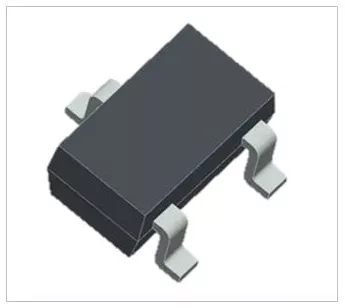
Required: P-Channel · Vdss ≥12V · Id ≥1A · Vgs(th) ≤2.5V · Rds(on) ≤300mΩ · SOT-23 · SMD
2. How to Find It on DigiKey
Go to DigiKey.com → Discrete Semiconductor Products → Transistors - FETs, MOSFETs - Single
Apply these filters:
- FET Type → P-Channel
- Technology → MOSFET (Metal Oxide)
- Drain to Source Voltage (Vdss) → 12V or higher
- Current - Continuous Drain (Id) → 1A or higher
- Vgs(th) (Max) → 2.5V or lower
- Rds On (Max) → 300mΩ or lower
- Package / Case → SOT-23-3 (TO-236)
- Part Status → Active
Tip: For P-Channel MOSFETs, DigiKey shows Vgs(th) as an absolute value (e.g., 1.5V) even though the actual threshold is negative (−1.5V). Filter using the absolute value as shown.
3. Key Specifications & What They Mean
| Specification | Required | Why |
|---|---|---|
| FET Type | P-Channel | High-side switch; source to supply, drain to load. |
| Vdss | ≥12V | Must block 5V supply; 12V gives margin. |
| Id | ≥1A | Module draws 300mA; ~3× margin. |
| Vgs(th) Max | ≤2.5V | Ensures full ON with 5V Vgs (GPIO LOW). |
| Rds(on) | ≤300mΩ | Low drop: 0.3Ω × 0.3A = 90mV loss. |
| Vgs Max | ≥8V | Gate tolerates 5V drive safely. |
| Power | ≥300mW | Covers worst-case dissipation with margin. |
| Package | SOT-23-3 | Compact SMD. |
| Temp Range | −55°C to +150°C | Standard MOSFET range. |
| RoHS | Yes | Compliance required. |
Important: When the MCU GPIO outputs 3.3V (HIGH), Vgs = 3.3 − 5 = −1.7V. This must be below the threshold for the MOSFET to fully turn OFF. With Vgs(th) ≤2.5V (meaning the FET starts turning ON at −2.5V), a −1.7V Vgs is safely below threshold and the FET stays OFF.
4. Selecting a Safe, Production-Ready Part
The filtered list will show matching parts. Before you pick one, check: Is it Active? Is stock available? Is the manufacturer reputable? Is a datasheet available?
Full checklist: How to Select a Safe, Production-Ready Component — EWskills Guide
5. Filtered DigiKey Link
➡ View Matching Parts — P-Ch MOSFET, SOT-23, Vgs(th)≤2.5V, Id≥1A, Rds(on)≤300mΩ