32. TVS Diode for 12V Automotive Supply Line Protection
John is designing an automotive electronic control module powered from the 12V vehicle battery.
The automotive supply line is exposed to harsh transients including load dump (up to 40V), alternator spikes, inductive switching, and reverse battery conditions.
To protect the module from these high-energy transients, he needs to place a unidirectional TVS diode across the 12V input.
Key requirements:
Normal battery voltage range is 9V to 16V (including cranking and charging up to ~14.8V)
TVS standoff voltage: 18V to 22V (above max normal voltage with safe margin)
Clamping voltage: ≤38V (to protect downstream automotive-grade components)
Peak pulse power: ≥600W for load dump transients
Must be AEC-Q101 qualified for automotive reliability
SMD package: SMB
The company's approved vendor list (AVL) specifies Littelfuse for circuit protection components, so the part must be selected from Littelfuse on DigiKey.
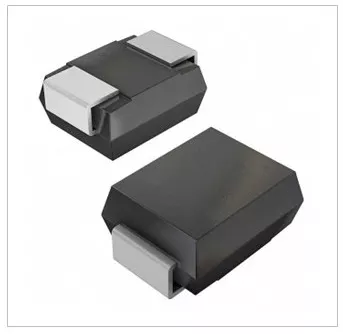
Help him select a suitable unidirectional, automotive-grade TVS diode from Littelfuse on DigiKey.
Visit DigiKey's TVS Diodes category and find a suitable part.
What is a TVS Diode?
A TVS diode is a special type of diode designed to protect sensitive circuits from voltage spikes (ESD, lightning surges, switching noise).
- Under normal operation → it stays off.
- During a surge → it switches on within < 1 ns, clamping the voltage to a safe level.
- Unlike MOVs, TVS diodes are precise, fast, and designed for semiconductor-level protection.
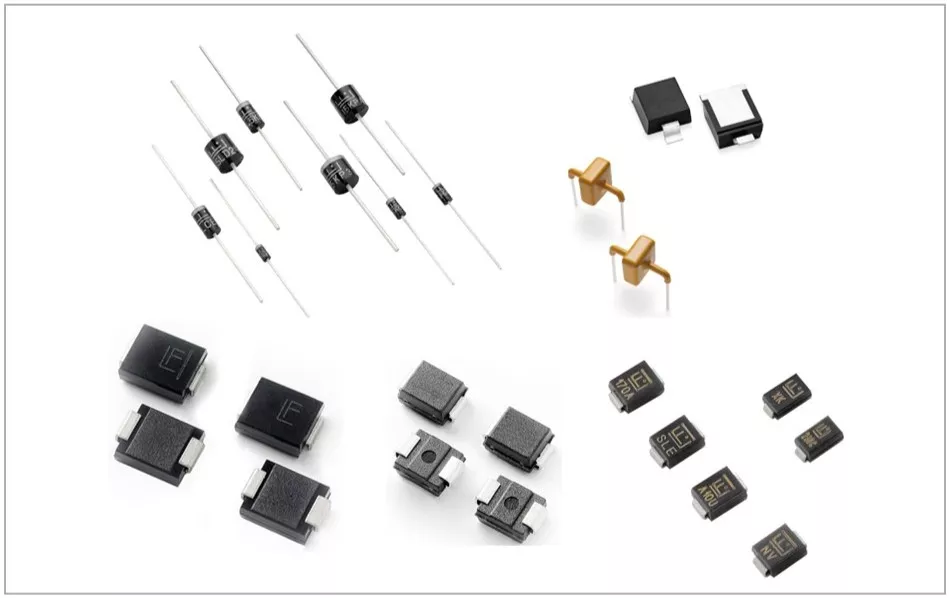
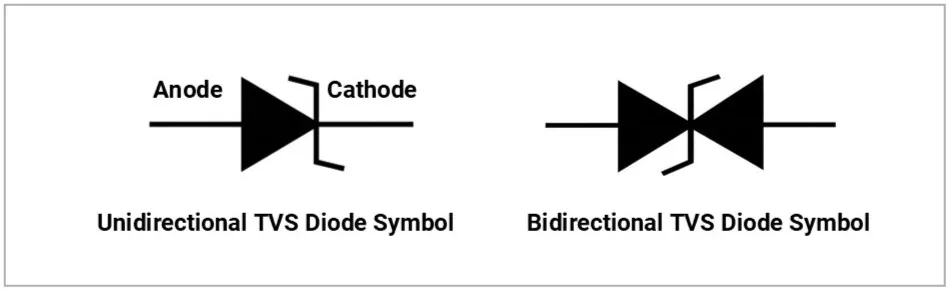
Schematic Symbols:
Why TVS Diodes are Important
Modern electronics (MCUs, USB, HDMI, automotive ECUs) run at 3.3 V / 5 V / 12 V — even a 10–20 V spike can kill them.
- TVS diodes clamp that surge instantly.
- They are used right at connectors, power rails, and data ports.
Simple TVS Diode Circuit
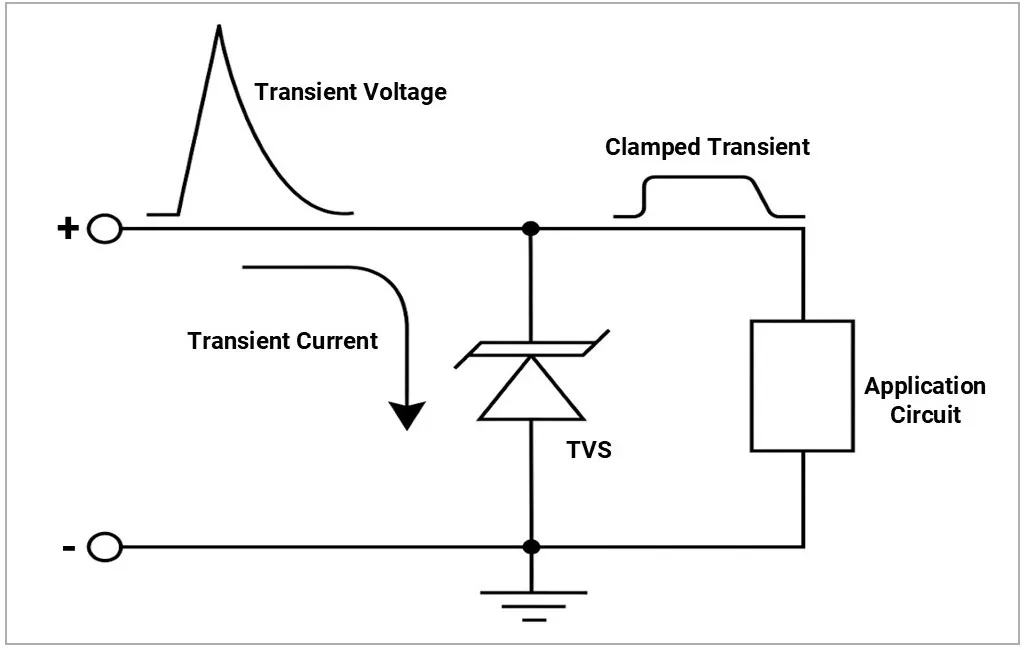
Practical Use Cases
- ESD protection: Human touch discharges up to 8 kV → TVS protects I/O pins.
- Automotive load dump: 12 V car battery line can surge up to 80 V → TVS clamps.
- Communication lines: RS-485, CAN bus, Ethernet → protected with TVS arrays.
- Consumer electronics: HDMI, USB, audio jacks.
- Industrial: Relay coils, PLC I/O.
Types of TVS Diodes
1) Based on Polarity
Polarity | Image | Description |
|---|---|---|
Unidirectional | 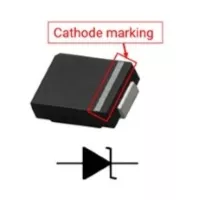 | Works like a Zener diode. Used for DC rails (e.g., 5 V supply). Symbol: Zener-like with clamping behaviour. |
Bi-directional | 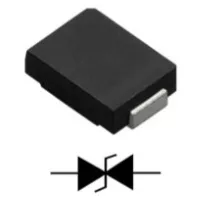 | Symmetric protection in both polarities. Used for AC signals or differential signals (USB, HDMI, CAN). Symbol: Two Zener-like diodes back-to-back. |
2) Based on Package / Power Rating
| Package | Image | Description |
|---|---|---|
| Through Hole | 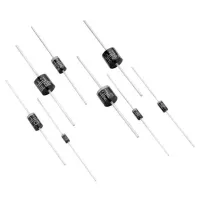 | Handles very high surge energy; used for industrial and heavy-duty protection. |
| High Power | 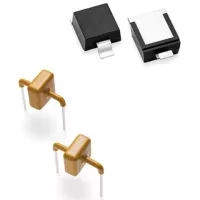 | Handles very high surge energy; used for industrial and heavy-duty protection. |
| SMD Packages | 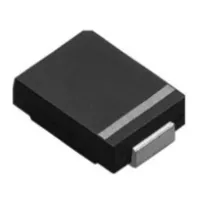 | Optimized for high-speed PCB layouts smaller footprints (like SOD-123) are for ESD, while larger ones (SMC) handle lightning or inductive surges. SOD-323, SOT-23, SMBJ, SMCJ |
| Arrays/IC Packages | 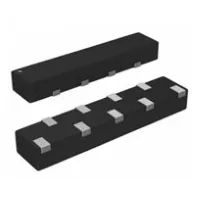 | Provides Multi-Channel Protection and space efficiency Used for High-Speed Signal Integrity (USB 3.0 or HDMI) QFN, SOT-23 arrays for USB/Ethernet. |
Key Specifications
- Maximum Stand-Off Voltage (VRWM)
- The highest continuous operating voltage the TVS can withstand without turning on.
- Always select VRWM slightly above your system’s normal voltage.
- Breakdown Voltage (VBR)
- The voltage at which the TVS begins to conduct significantly (tested at ~1 mA).
- Slightly above VRWM.
- Clamping Voltage (VC)
- The maximum voltage across the TVS during a surge at a given test current.
- This is the voltage your protected IC will see during a spike.
- Must be lower than the IC’s absolute maximum rating.
- Peak Pulse Current (IPP)
- The maximum surge current (Amps) the diode can handle for a specified waveform (usually 8/20 µs).
- Peak Pulse Power (PPP)
- Defines the energy-handling capability during a surge (IPP × VC).
- Common values: 400 W, 600 W, 1500 W, 3000 W.
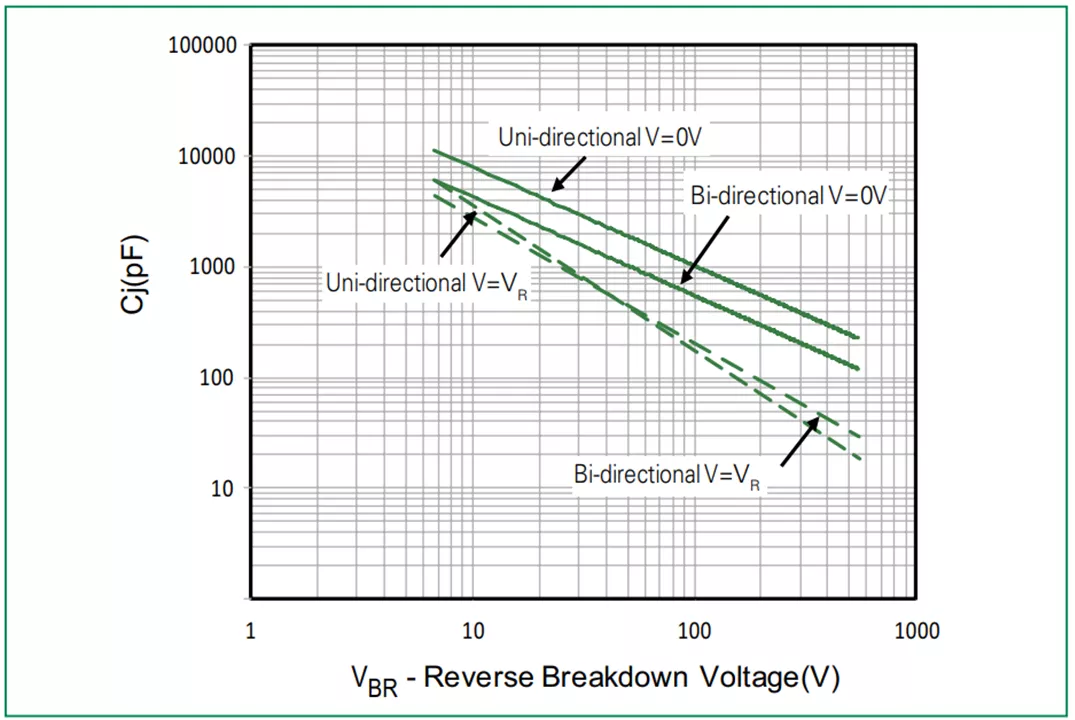
- Capacitance (C)
- TVS diodes behave like small capacitors.
- High capacitance can distort high-speed signals (USB 3.0, HDMI, Ethernet).
- For high-speed lines → always use low-capacitance TVS arrays (<1 pF).
- Response Time
- TVS diodes are ultra-fast (<1 ns).
- They can catch ESD spikes that MOVs or fuses cannot.
Example F9321TR-ND TVS Diode Specafications:
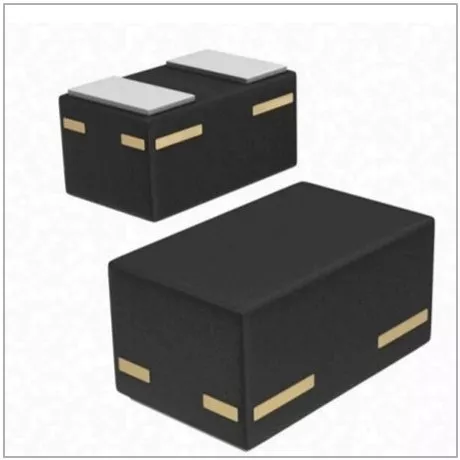
Specifications | Description |
|---|---|
Direction | Bidirectional |
Maximum Stand-Off Voltage (VRWM) | 5.3V(Max) |
Breakdown Voltage (VBR) | 6.8V(Min) |
Voltage - Clamping (Max) @ Ipp | 12V |
Current - Peak Pulse | 3A (8/20µs) |
Peak Pulse Power (PPK) | 40W |
Capacitance | 0.35pF @ 1MHz |
Response Time | < 1 ns |
Package | SOD-882 |
Manufacturer | Littelfuse Inc. |
RoHS Status | ROHS3 Compliant |
Important Datasheet Curves
V-I characteristic (unidirectional vs bidirectional):
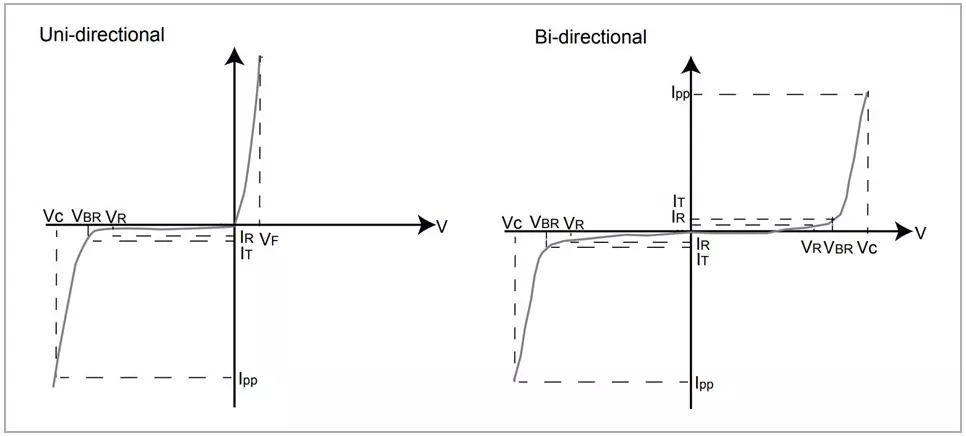
- VR Stand-off Voltage -- Maximum voltage that can be applied to the TVS without operation
- VBR Breakdown Voltage -- Maximum voltage that flows though the TVS at a specified test current (IT)
- VC Clamping Voltage -- Peak voltage measured across the TVS at a specified Ippm (peak impulse current)
- IR Reverse Leakage Current -- Current measured at VR
- VF Forward Voltage Drop for Uni-directional
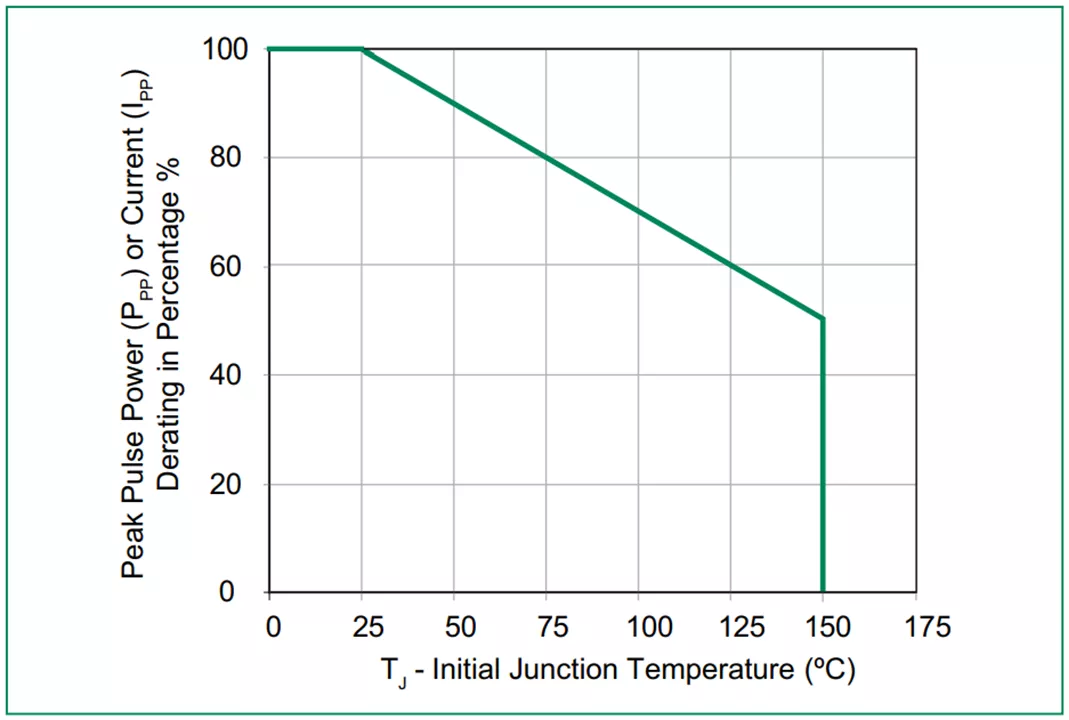
Power derating curve vs temperature.
Capacitance vs bias voltage curve (for signal integrity)
How to Select a TVS Diode (Step by Step)
- Know your system voltage.
- Example: USB 5 V → choose TVS with VRWM ≥ 5 V.
- Check IC's max voltage rating.
- Ensure TVS VC is below IC max rating.
- Check power rating.
- Choose the PPK rating based on the expected surge environment (e.g., 600 W for USB, 1500 W for automotive).
- Choose unidirectional or bidirectional.
- DC rail → unidirectional.
- AC/differential (USB, HDMI) → bidirectional.
- Check capacitance.
- High-speed signals need <1 pF.
- Power lines can tolerate higher capacitance.
Application Circuit Diagrams
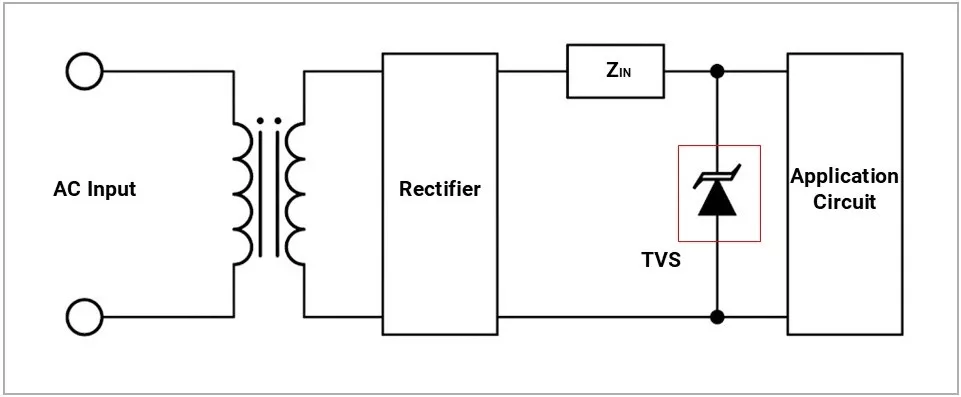
- TVS Diode Overvoltage Protection Circuit Diagram
TVS diode across the DC input rail.
- USB Port Circuit Protection Using Bidirectional TVS Diodes
- TVS array across D+/D− lines.
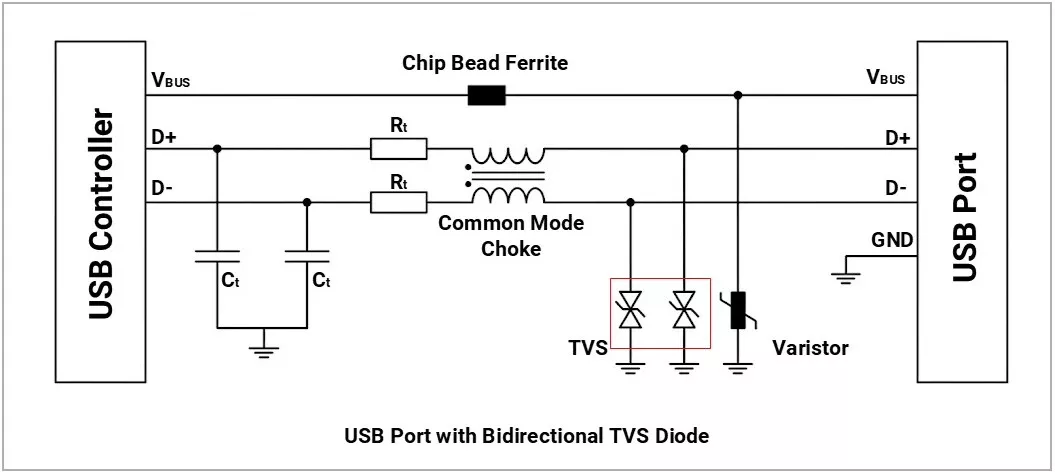
Failure Modes
A TVS diode primarily fails as a short circuit
- Short circuit: diode permanently conducts → rail gets clamped.
Comparison with Other Devices
Different surge protection devices exist, each with its strengths and trade-offs. TVS diodes are typically used for fast, precise IC protection, while MOVs and GDTs are chosen for higher-energy surges like mains spikes or lightning.
Feature | TVS Diode | MOV (Metal Oxide Varistor) | GDT (Gas Discharge Tube) |
|---|---|---|---|
Image | 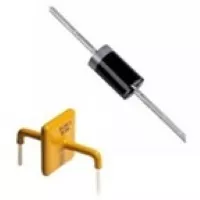 | 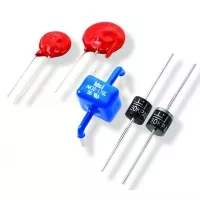 | 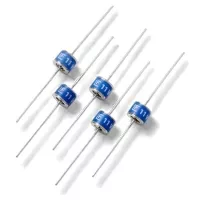 |
Response Speed | Ultra-fast (<1 ns) → ESD & fast spikes | Fast (100 ns – µs) → mains surges | Slow (µs–ms) → lightning surges |
Clamping Precision | Very precise (protects 3.3 V, 5 V, 12 V ICs) | Moderate (hundreds of volts range) | Poor (fires at 75–600 V, not exact) |
Energy Handling | Low (Watts level) | Medium–High (tens–thousands of Joules) | Very High (kiloamp lightning strikes) |
Best Application | IC-level, USB, HDMI, RS-485, automotive pins | AC mains, SMPS, automotive load dump | Telecom lines, outdoor gear, power grids |
Lifetime | Good for repeated ESD | Degrades after multiple surges (aging) | Very durable for big surges, but slow |
- Basically
- TVS = fast IC protection, MOV = mains/automotive surge absorber, GDT = heavy lightning defense.
- TVS vs Zener diode:
- TVS is designed for surge absorption, not regulation.
- Zener is for a steady-state voltage reference.
Common mistakes to avoid
- Selecting VRWM too close to system voltage → causes unwanted conduction
- Ignoring clamping voltage (VC) → protected IC may still get damaged
- Choosing insufficient power rating (PPP) → diode fails during surge
- Using wrong type (unidirectional vs bidirectional) for the application
- Placing TVS far from connector/input → reduces protection effectiveness
- Poor grounding/layout → increases clamping voltage due to inductance
- Using high-capacitance TVS on high-speed lines → signal distortion
- Assuming one TVS protects all lines → mismatched protection levels
- Not checking datasheet waveforms (ESD, 8/20 µs, etc.)
- Ignoring long-term degradation from repeated surgesv