45. Combinational Arithmetic Circuits
Question.1
A half adder is to be built using only 2‑input NAND gates. No other gate types are available. What is the minimum number of NAND gates required to produce both Sum and Carry?
Combinational arithmetic circuits produce results directly from the present input values.
Binary Inputs → Arithmetic / Logic Circuit → ResultBinary Addition
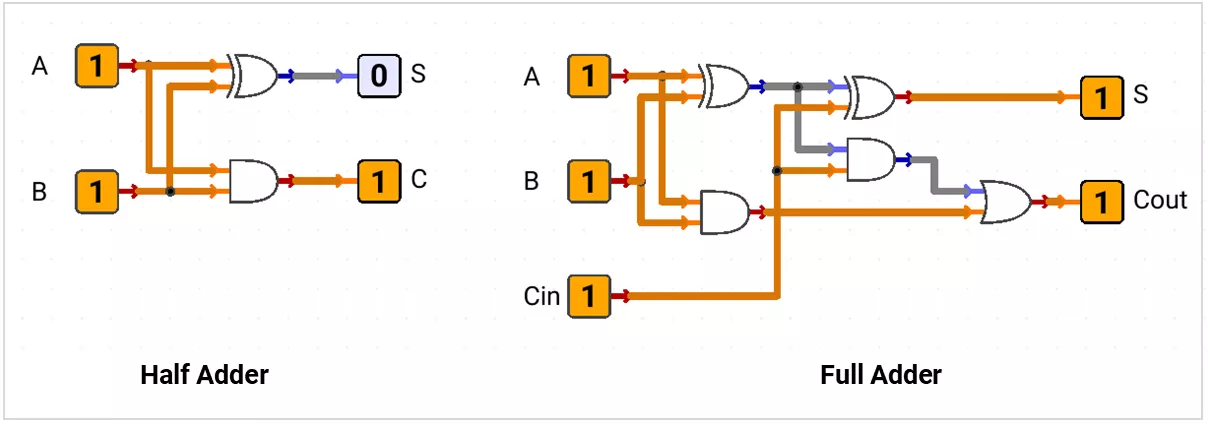
Binary addition produces a Sum and Carry. A Half Adder uses A and B; a Full Adder also includes the incoming carry Cin.
| Circuit | Inputs | Sum | Carry |
|---|---|---|---|
| Half Adder | A, B | S = A ⊕ B | C = A · B |
| Full Adder | A, B, Cin | S = A ⊕ B ⊕ Cin | Cout = A · B + Cin · (A ⊕ B) |
- Sum is formed by XOR: it is HIGH when an odd number of input bits are HIGH.
- Carry is generated when the addition produces a value greater than one bit.
4-Bit Ripple-Carry Adder
Four stages add A3_A2_A1_A0 and B3_B2_B1_B0. The carry from each bit becomes the Cin of the next higher bit.
C0 = 0At bit position n:
Sn = An ⊕ Bn ⊕ CnSn is the Sum bit. The next carry is:
Cn+1 = An · Bn + Cn · (An ⊕ Bn)The 4-bit output keeps the lower four Sum bits.
S = (A + B) mod 16Cout = 1 → unsigned result exceeded the 4-bit range
1111 + 0110 = 1 0101 → S = 0101, Cout = 1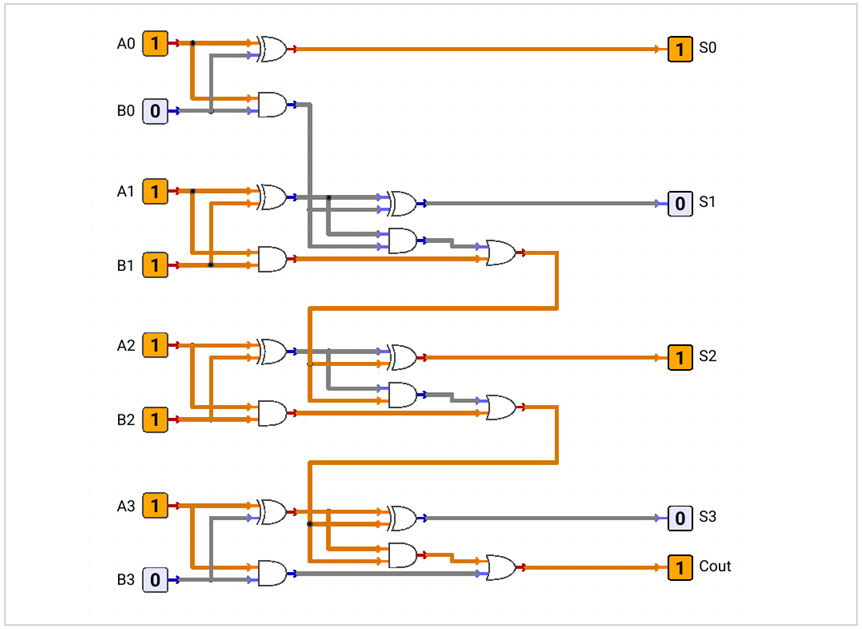
Binary Subtraction
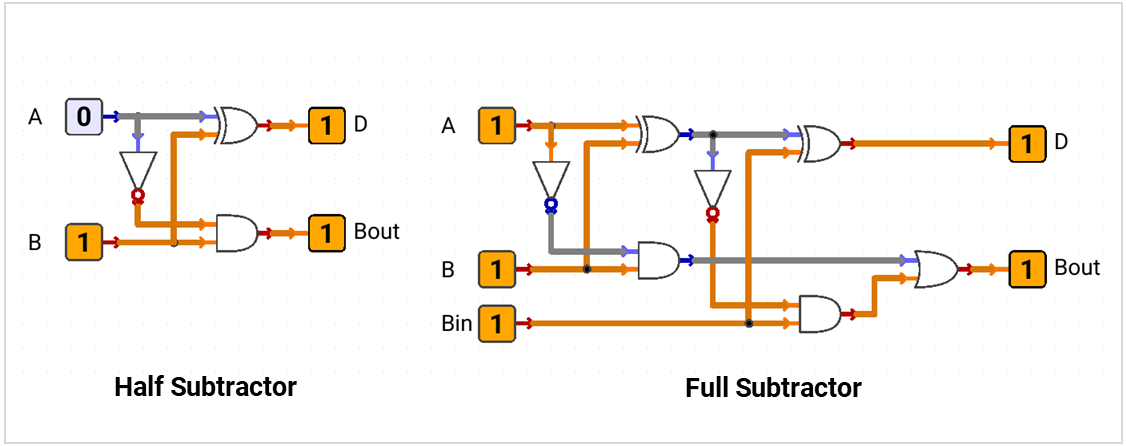
Binary subtraction produces a Difference and Borrow. A Full Subtractor also includes the incoming borrow Bin.
| Circuit | Inputs | Difference | Borrow |
|---|---|---|---|
| Half Subtractor | A, B | D = A ⊕ B | Bout = A' · B |
| Full Subtractor | A, B, Bin | D = A ⊕ B ⊕ Bin | Bout = A' · B + Bin · (A ⊕ B)' |
- Difference is formed by XOR.
- Borrow becomes HIGH when the current bit needs a value from the next higher bit.
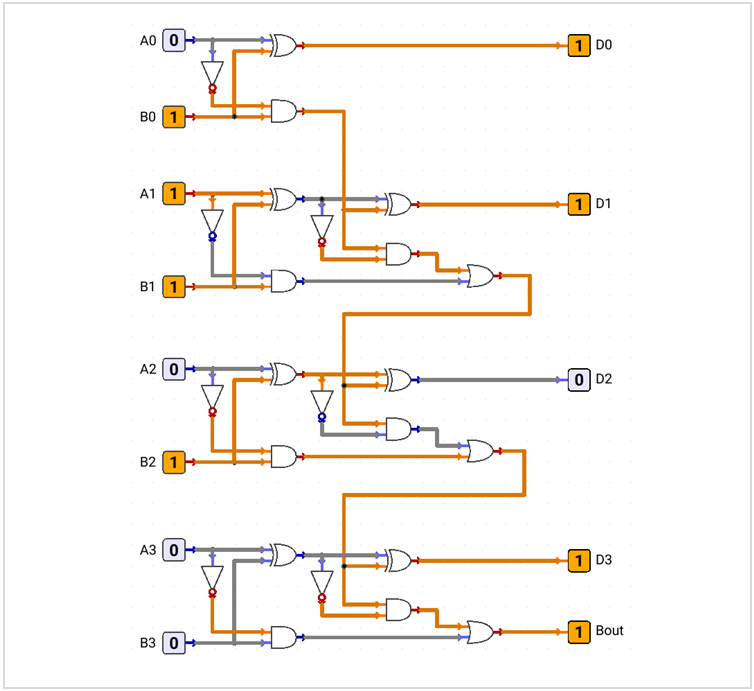
4-Bit Ripple-Borrow Subtractor
Each stage subtracts Bn and incoming borrow bn from An. The generated borrow goes to the next higher bit.
b0 = 0The LSB starts with no incoming borrow.
Dn = An ⊕ Bn ⊕ bnDn is the Difference bit at position n.
bn+1 = An' · Bn + bn · (An ⊕ Bn)'A borrow is generated when An is not sufficient to subtract Bn and the incoming borrow.
D = (A - B) mod 16For a 4-bit subtractor, only the lower 4 result bits are stored in D.
Bout = 1 → unsigned underflow occurred
This means A < B, so the unsigned subtraction required a borrow beyond the MSB.
Example:
0010 - 0111 = 1 1011 → D = 1011, Bout = 1The 4-bit result is 1011, while Bout = 1 indicates that 2 < 7.
2-Bit Unsigned Multiplier
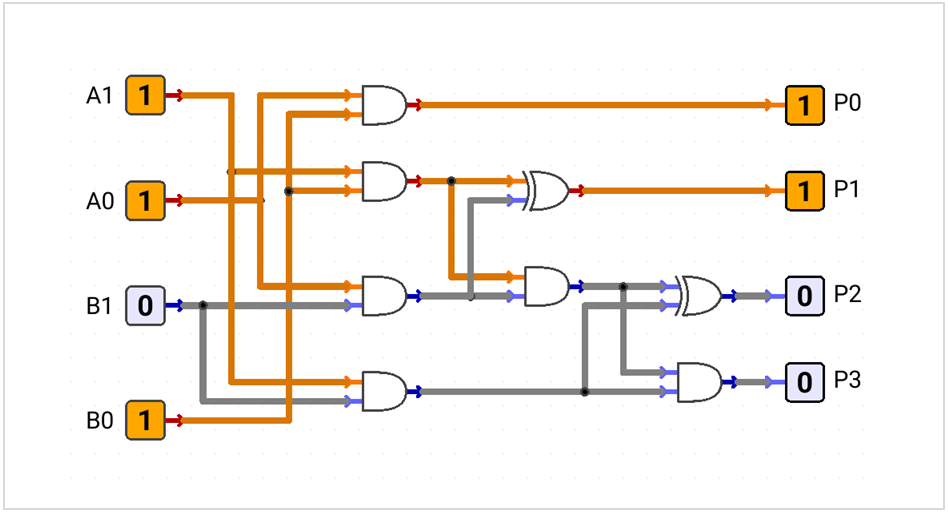
Let A = A1_A0 and B = B1_B0. AND gates first generate four partial products.
X0 = A0 · B0      X1 = A1 · B0
X2 = A0 · B1      X3 = A1 · B1
The partial products are then added by bit position:
P0 = X0
P1 = X1 ⊕ X2      C1 = X1 · X2
P2 = X3 ⊕ C1      P3 = X3 · C1
2-bit × 2-bit → 4-bit product P3_P2_P1_P0
11₂ × 01₂ = 0011₂
Signed-Magnitude Multiplier
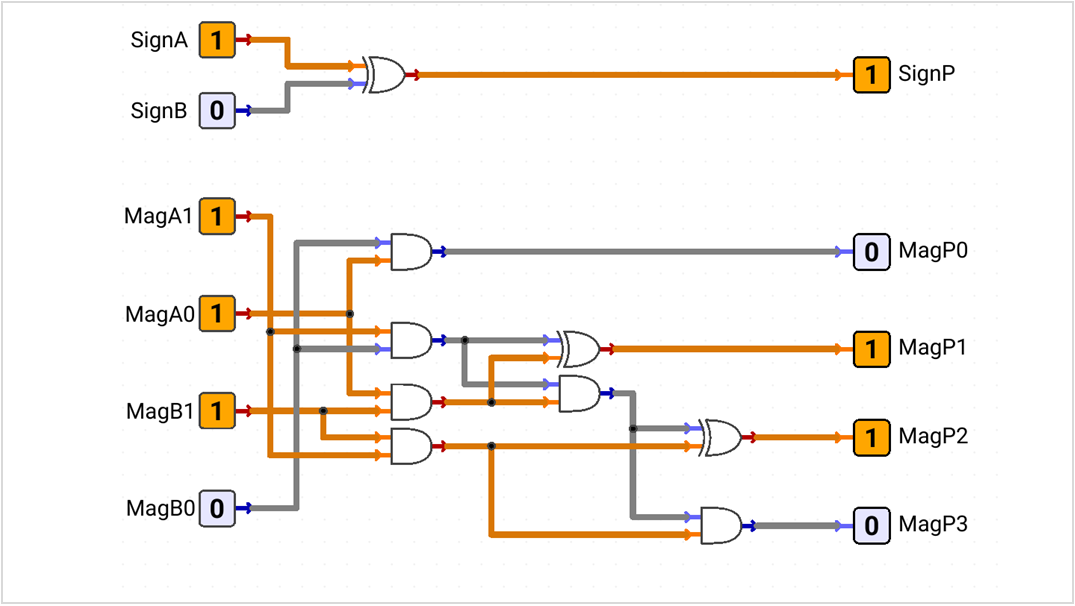
Signed-magnitude multiplication handles the sign and magnitude separately.
The product is negative only when the input signs are different, so XOR generates the sign:
SignP = SignA ⊕ SignBThe magnitude bits are multiplied as unsigned values:
MagnitudeP = MagA × MagBMaximum 2-bit magnitude = 3 → maximum product magnitude = 9 = 1001₂
A = 1,11 (-3), B = 0,10 (+2) → Product = 1,0110 (-6)Note: If MagnitudeP = 0000, zero-detection logic may force SignP = 0 to avoid negative zero.
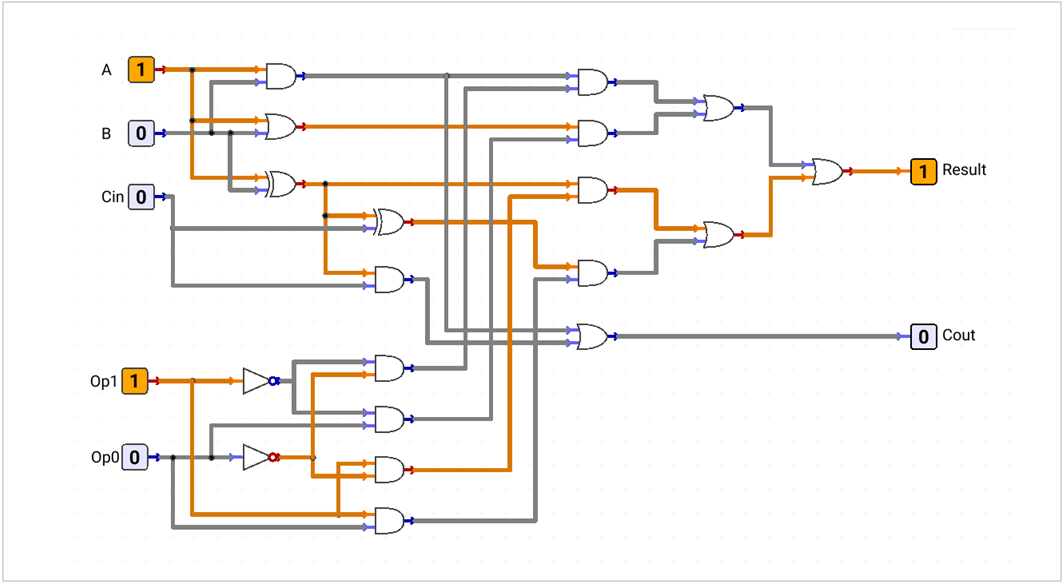
1-Bit ALU Slice
The ALU computes several functions in parallel. Op1_Op0 selects which result appears at the output.
| Op1 | Op0 | Operation | Result |
|---|---|---|---|
| 0 | 0 | AND | A · B |
| 0 | 1 | OR | A + B |
| 1 | 0 | XOR | A ⊕ B |
| 1 | 1 | ADD | A ⊕ B ⊕ Cin |
The ADD path also generates:
Cout = A · B + Cin · (A ⊕ B)Note: Cout is meaningful when Op1_Op0 = 11 selects ADD.