45. Combinational Arithmetic Circuits
Question.6
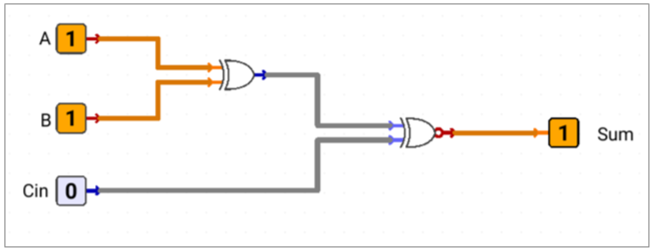
An engineer builds the sum section of a full adder using two stages:
The first gate produces X = A ⊕ B.
The second stage combines X with Cin.
During testing, the output is found to be the complement of the expected full-adder sum for every input combination. Which single modification corrects the circuit?
Combinational arithmetic circuits produce results directly from the present input values.
Binary Inputs → Arithmetic / Logic Circuit → ResultBinary Addition
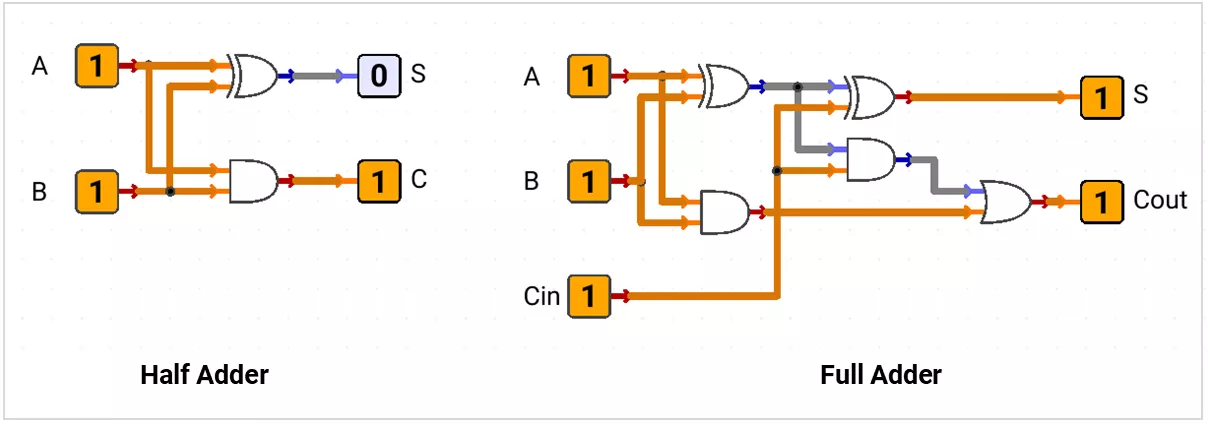
Binary addition produces a Sum and Carry. A Half Adder uses A and B; a Full Adder also includes the incoming carry Cin.
| Circuit | Inputs | Sum | Carry |
|---|---|---|---|
| Half Adder | A, B | S = A ⊕ B | C = A · B |
| Full Adder | A, B, Cin | S = A ⊕ B ⊕ Cin | Cout = A · B + Cin · (A ⊕ B) |
- Sum is formed by XOR: it is HIGH when an odd number of input bits are HIGH.
- Carry is generated when the addition produces a value greater than one bit.
4-Bit Ripple-Carry Adder
Four stages add A3_A2_A1_A0 and B3_B2_B1_B0. The carry from each bit becomes the Cin of the next higher bit.
C0 = 0At bit position n:
Sn = An ⊕ Bn ⊕ CnSn is the Sum bit. The next carry is:
Cn+1 = An · Bn + Cn · (An ⊕ Bn)The 4-bit output keeps the lower four Sum bits.
S = (A + B) mod 16Cout = 1 → unsigned result exceeded the 4-bit range
1111 + 0110 = 1 0101 → S = 0101, Cout = 1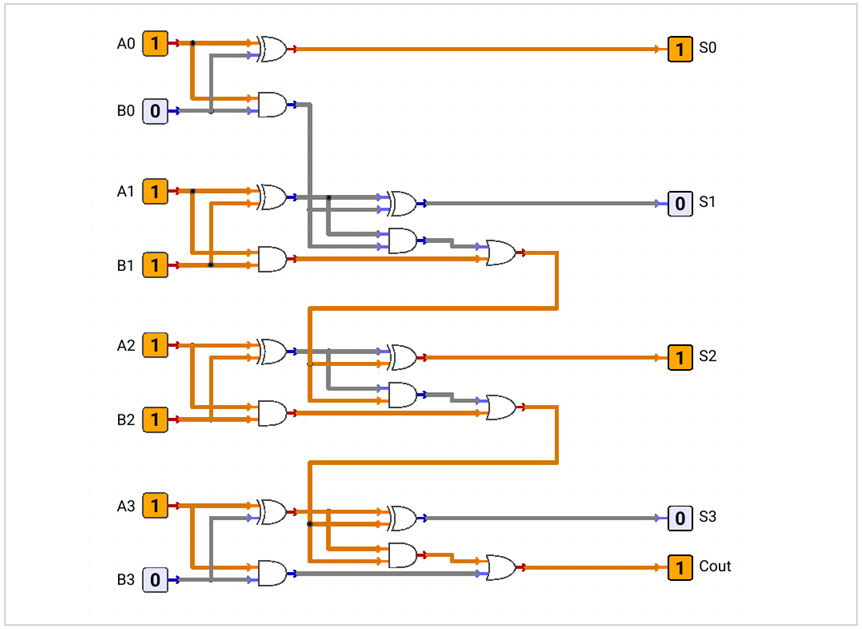
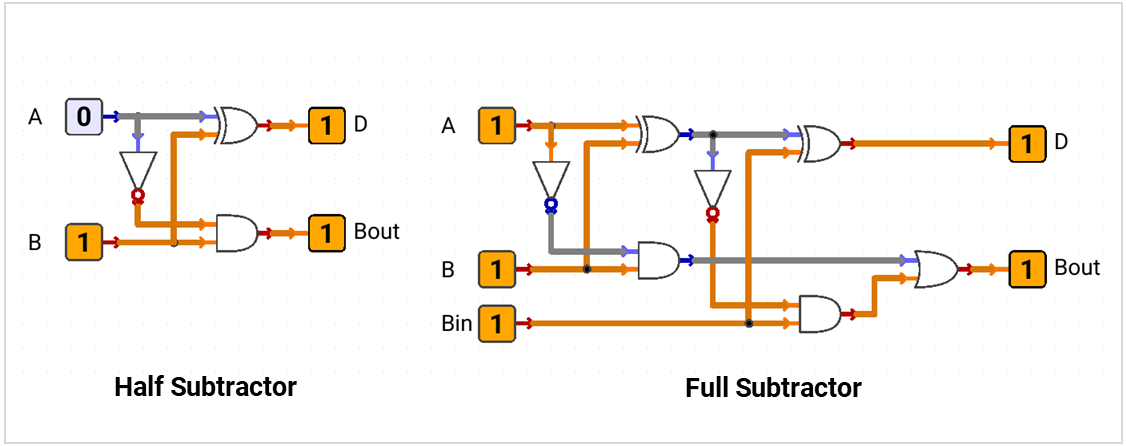
Binary Subtraction
Binary subtraction produces a Difference and Borrow. A Full Subtractor also includes the incoming borrow Bin.
| Circuit | Inputs | Difference | Borrow |
|---|---|---|---|
| Half Subtractor | A, B | D = A ⊕ B | Bout = A' · B |
| Full Subtractor | A, B, Bin | D = A ⊕ B ⊕ Bin | Bout = A' · B + Bin · (A ⊕ B)' |
- Difference is formed by XOR.
- Borrow becomes HIGH when the current bit needs a value from the next higher bit.
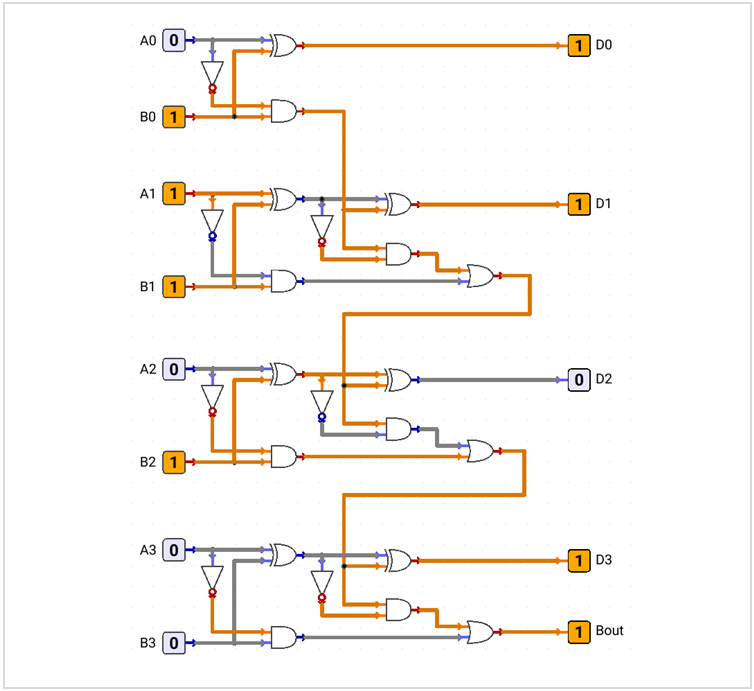
4-Bit Ripple-Borrow Subtractor
Each stage subtracts Bn and incoming borrow bn from An. The generated borrow goes to the next higher bit.
b0 = 0The LSB starts with no incoming borrow.
Dn = An ⊕ Bn ⊕ bnDn is the Difference bit at position n.
bn+1 = An' · Bn + bn · (An ⊕ Bn)'A borrow is generated when An is not sufficient to subtract Bn and the incoming borrow.
D = (A - B) mod 16For a 4-bit subtractor, only the lower 4 result bits are stored in D.
Bout = 1 → unsigned underflow occurred
This means A < B, so the unsigned subtraction required a borrow beyond the MSB.
Example:
0010 - 0111 = 1 1011 → D = 1011, Bout = 1The 4-bit result is 1011, while Bout = 1 indicates that 2 < 7.
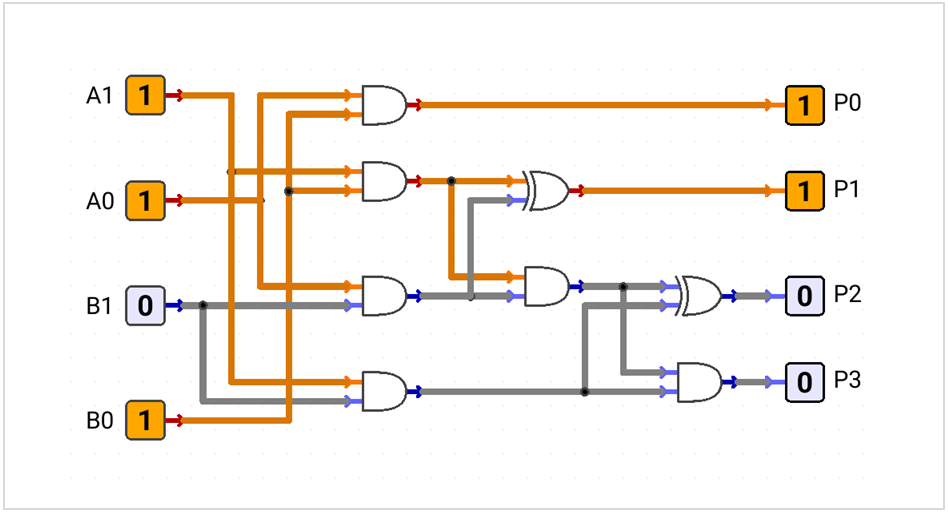
2-Bit Unsigned Multiplier
Let A = A1_A0 and B = B1_B0. AND gates first generate four partial products.
X0 = A0 · B0      X1 = A1 · B0
X2 = A0 · B1      X3 = A1 · B1
The partial products are then added by bit position:
P0 = X0
P1 = X1 ⊕ X2      C1 = X1 · X2
P2 = X3 ⊕ C1      P3 = X3 · C1
2-bit × 2-bit → 4-bit product P3_P2_P1_P0
11₂ × 01₂ = 0011₂
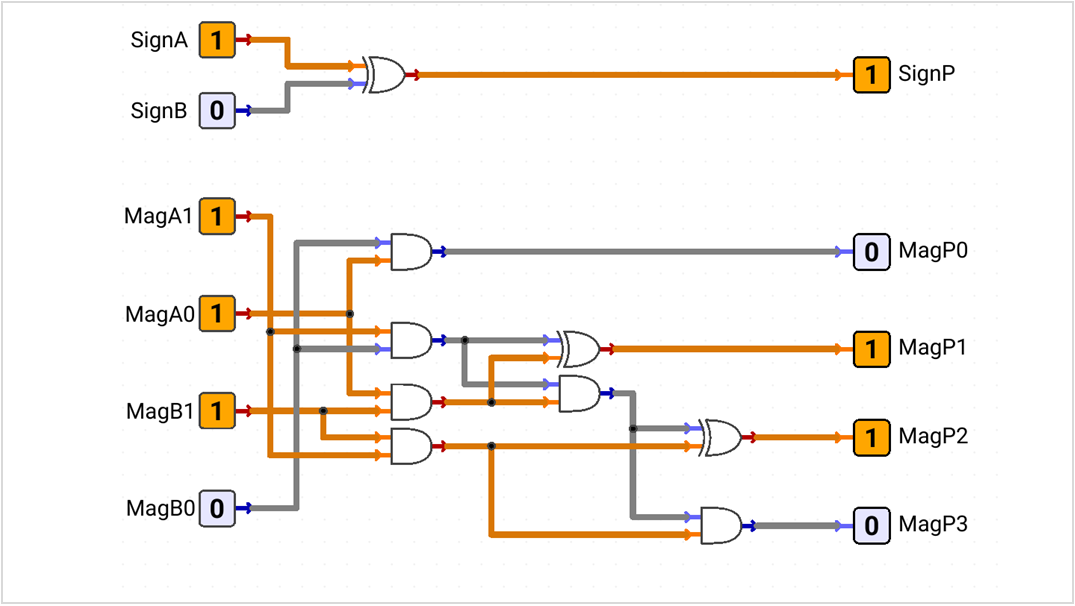
Signed-Magnitude Multiplier
Signed-magnitude multiplication handles the sign and magnitude separately.
The product is negative only when the input signs are different, so XOR generates the sign:
SignP = SignA ⊕ SignBThe magnitude bits are multiplied as unsigned values:
MagnitudeP = MagA × MagBMaximum 2-bit magnitude = 3 → maximum product magnitude = 9 = 1001₂
A = 1,11 (-3), B = 0,10 (+2) → Product = 1,0110 (-6)Note: If MagnitudeP = 0000, zero-detection logic may force SignP = 0 to avoid negative zero.
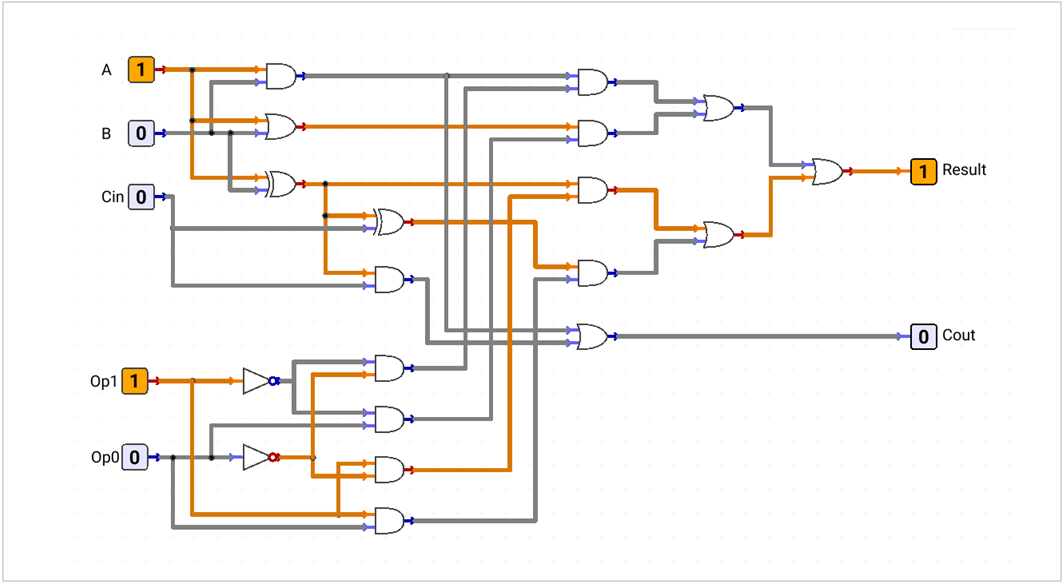
1-Bit ALU Slice
The ALU computes several functions in parallel. Op1_Op0 selects which result appears at the output.
| Op1 | Op0 | Operation | Result |
|---|---|---|---|
| 0 | 0 | AND | A · B |
| 0 | 1 | OR | A + B |
| 1 | 0 | XOR | A ⊕ B |
| 1 | 1 | ADD | A ⊕ B ⊕ Cin |
The ADD path also generates:
Cout = A · B + Cin · (A ⊕ B)Note: Cout is meaningful when Op1_Op0 = 11 selects ADD.