Number Systems and Data Conversions Quick Reference Guide
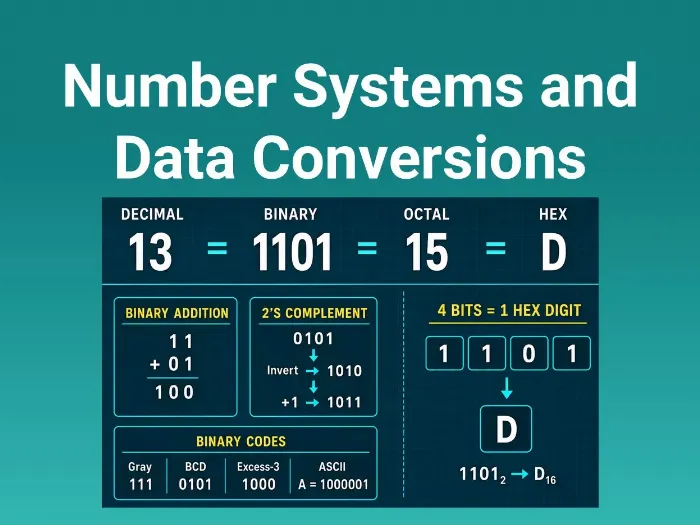
Digital Electronics
Digital electronics processes the information using discrete values or logic levels.
Digital circuits represent binary values using voltage ranges.
In a simplified 5 V logic example,
| 5 V | Logic 1 |
| 0 V or GND | Logic 0 |
Actual HIGH and LOW voltage thresholds depend on the logic family.
Number Systems
Decimal Number System
Digits: 0 to 9. (0,1,2,3,4,5,6,7,8,9)
Base = 10
Examples: - 3, 5, 87, 123, 543
Commonly used by humans for everyday numerical representation.
Binary Number System
Digits: 0 and 1
Base = 2
Examples: - 0, 1, 10, 1001, 00110101, 1110001011010100
It is used in digital electronics because it enables –
- Easy implementation.
- High reliability.
- Simple circuit design.
Octal Number System
Digits: 0 to 7 (0,1,2,3,4,5,6,7)
Base = 8
Examples: - 4, 7, 34, 23, 17 (Digits 8 and 9 do not appear in an octal number.)
Octal provides a compact representation of binary because one octal digit corresponds to three binary bits.
Hexadecimal Number System
Digits: 0 to 9 and A to F (0,1,2,3,4,5,6,7,8,9,A,B,C,D,E,F)
Base = 16
Examples: - 2, 4, C, D, 3D, 2A, 23B, BD8, 45F
- Used to represent long binary numbers in a compact form.
- One hexadecimal digit corresponds to four binary bits.
Number System Conversion Table (0–20)
| Decimal | Binary | Octal | Hexadecimal |
|---|---|---|---|
| 0 | 0 | 0 | 0 |
| 1 | 1 | 1 | 1 |
| 2 | 10 | 2 | 2 |
| 3 | 11 | 3 | 3 |
| 4 | 100 | 4 | 4 |
| 5 | 101 | 5 | 5 |
| 6 | 110 | 6 | 6 |
| 7 | 111 | 7 | 7 |
| 8 | 1000 | 10 | 8 |
| 9 | 1001 | 11 | 9 |
| 10 | 1010 | 12 | A |
| 11 | 1011 | 13 | B |
| 12 | 1100 | 14 | C |
| 13 | 1101 | 15 | D |
| 14 | 1110 | 16 | E |
| 15 | 1111 | 17 | F |
| 16 | 10000 | 20 | 10 |
| 17 | 10001 | 21 | 11 |
| 18 | 10010 | 22 | 12 |
| 19 | 10011 | 23 | 13 |
| 20 | 10100 | 24 | 14 |
Data Conversion
Same value can be represented in different number systems.
Decimal to Binary
Decimal number 45 is converted into binary with following method:
| Division | Quotient | Remainder |
|---|---|---|
| 45 ÷ 2 | 22 | 1 (LSB) |
| 22 ÷ 2 | 11 | 0 |
| 11 ÷ 2 | 5 | 1 |
| 5 ÷ 2 | 2 | 1 |
| 2 ÷ 2 | 1 | 0 |
| 1 ÷ 2 | 0 | 1 (MSB) |
45₁₀ = 101101₂Binary to Decimal
To convert binary number 10101 into decimal:
| Position (n) | 4 | 3 | 2 | 1 | 0 |
|---|---|---|---|---|---|
| Binary digits: (from MSB to LSB) | 1 | 0 | 1 | 0 | 1 |
| Positional Weights: 2ⁿ | 16 | 8 | 4 | 2 | 1 |
| Product of Weights and binary digit | 16 | 0 | 4 | 0 | 1 |
| Sum | 16 + 0 + 4 + 0 + 1 = 21 | ||||
Examples:
10101₂ = 21₁₀
110111₂ = 55₁₀
1001₂ = 9₁₀
For an n-bit unsigned binary number, the maximum value is 2ⁿ − 1.
For 3-bit, highest value is 2³ – 1 = 8 – 1 = 7
For 4-bit, highest value is 2⁴ – 1 = 16 – 1 = 15
Binary to Octal
Group 3 Binary Digits from LSB and write equivalent Octal Digit
Examples:
101100₂ = (101 100)₂ = 54₈
1011₂ = (001 011)₂ = 13₈
Octal to Binary
Represent each Octal digit to its equivalent 3-digit Binary Number
Examples: -
34₈ = (011 100)₂ = 011100₂
65₈ = (110 101)₂ = 110101₂
Binary Equivalent Octal Table
| Binary | Octal |
|---|---|
000 | 0 |
001 | 1 |
010 | 2 |
011 | 3 |
100 | 4 |
101 | 5 |
110 | 6 |
111 | 7 |
Binary to Hexadecimal
Group 4 Binary Digits from LSB and write equivalent Hexadecimal Digit
Examples:
00110111₂ = (0011 0111)₂ = 37₁₆
10100010₂ = (1010 0010)₂ = A2₁₆
11101011₂ = (1110 1011)₂ = EB₁₆
Hexadecimal to Binary
Represent each Hexadecimal Digit to its equivalent 4-digit Binary or 4-bit Binary
5F₁₆ = (0101 1111)₂ = 01011111₂
3D9₁₆ = (0011 1101 1001)₂ = 001111011001₂
A54₁₆ = (1010 0101 0100)₂ = 101001010100₂
Binary equivalent Hexadecimal
| Binary | Hexadecimal | Binary | Hexadecimal |
|---|---|---|---|
0000 | 0 | 1000 | 8 |
0001 | 1 | 1001 | 9 |
0010 | 2 | 1010 | A |
0011 | 3 | 1011 | B |
0100 | 4 | 1100 | C |
0101 | 5 | 1101 | D |
0110 | 6 | 1110 | E |
0111 | 7 | 1111 | F |
Decimal to Hexadecimal
Convert the Decimal into Binary and convert the Binary into Hexadecimal
Example: Decimal number = 78₁₀
| Division | Quotient | Remainder |
|---|---|---|
| 78 ÷ 2 | 39 | 0 (LSB) |
| 39 ÷ 2 | 19 | 1 |
| 19 ÷ 2 | 9 | 1 |
| 9 ÷ 2 | 4 | 1 |
| 4 ÷ 2 | 2 | 0 |
| 2 ÷ 2 | 1 | 0 |
| 1 ÷ 2 | 0 | 1 (MSB) |
78₁₀ = 1001110₂ = (0100 1110)₂ = 4E₁₆
78₁₀ = 4E₁₆
Hexadecimal to Decimal
Convert the Hexadecimal into Binary and convert the Binary into Decimal
Example: - Hexadecimal number = D4₁₆
D4₁₆ = (1101 0100)₂ = 11010100₂| Position (n) | 7 | 6 | 5 | 4 | 3 | 2 | 1 | 0 |
|---|---|---|---|---|---|---|---|---|
| Binary digits: (from MSB to LSB) | 1 | 1 | 0 | 1 | 0 | 1 | 0 | 0 |
| Positional Weights: 2ⁿ | 128 | 64 | 32 | 16 | 8 | 4 | 2 | 1 |
| Product of Weights and binary digit | 128 | 64 | 0 | 16 | 0 | 4 | 0 | 0 |
| Sum | 128 + 64 + 0 + 16 + 0 + 4 + 0 + 0 = 212 | |||||||
D4₁₆ = 212₁₀Octal to Decimal
Convert the Octal to Binary and then Binary to Decimal.
31₈ = (011 001)₂ = 11001₂ = 25₁₀
123₈ = (001 010 011)₂ = 1010011₂ = 83₁₀
234₈ = (010 011 100)₂ = 10011100₂ = 156₁₀
Decimal to Octal
Convert the Decimal to Binary and then Binary to Octal.
15₁₀ = 1111₂ = (001 111)₂ = 17₈
52₁₀ = 110100₂ = (110 100)₂ = 64₈
197₁₀ = 11000101₂ = (011 000 101)₂ = 305₈
Hexadecimal to Octal
Convert Hexadecimal to Binary and then Binary to Octal.
Example: - Hexadecimal Number: - 72C₁₆
| Hexadecimal Number: | 7 | 2 | C | |||||||||
|---|---|---|---|---|---|---|---|---|---|---|---|---|
| Equivalent Binary Number: | 0 | 1 | 1 | 1 | 0 | 0 | 1 | 0 | 1 | 1 | 0 | 0 |
| Equivalent Octal Number | 3 | 4 | 5 | 4 | ||||||||
4F0₁₆ = (0100 1111 0000)₂ = (010 011 110 000)₂ = 2360₈
AD₁₆ = (1010 1101)₂ = (010 101 101)₂ = 255₈
Octal to Hexadecimal
Convert Octal to Binary and then Binary to Hexadecimal.
Examples: -
31₈ = (011 001)₂ = (0001 1001)₂ = 19₁₆
123₈ = (001 010 011)₂ = (0101 0011)₂ = 53₁₆
305₈ = (011 000 101)₂ = (1100 0101)₂ = C5₁₆
Binary Arithmetic
Binary Addition
Suppose A and B are two 1-bit binary numbers. The sum of A and B can be
| A | B | Sum | Carry |
|---|---|---|---|
0 | 0 | 0 | 0 |
0 | 1 | 1 | 0 |
1 | 0 | 1 | 0 |
1 | 1 | 0 | 1 |
Examples: -
Suppose A = 101 and B = 001
| A | 1 | 0 | 1 |
|---|---|---|---|
| B | 0 | 0 | 1 |
| Carry from previous bit | 1 | ||
| Sum | 1 | 1 | 0 |
011₂ + 011₂ = 110₂
1010₂ + 0110₂ = 10000₂ (Equivalently: 10 + 6 = 16)
Signed Binary Representation
In common signed representations, the MSB indicates the sign.
MSB represents sign bit.
MSB = 0 | Positive Value |
MSB = 1 | Negative Value |
Remaining bits represents value depending on representation method.
Signed Binary Representation Methods:
- Sign-Magnitude Representation
- 1’s Complement
- 2’s Complement
Sign-Magnitude Representation
Represent number as: Sign (MSB) and Magnitude (Remaining Bits).
Example for 4-bit signed magnitude representation.
0101 = +5
1101 = -5
Limitations:
- Represents 0 twice (
1000,0000) - Arithmetic operations become more complex
1’s Complement
Negative Numbers obtained by inverting all bits of positive number
Examples: -
| Numbers | Operations |
|---|---|
-3 | Given number |
011 | Represent equivalent binary of +3 |
100 | Take 1’s complement (invert 1 to 0 and 0 to 1) |
+3 = 011
-0 = 111
Limitation: -
- 1's complement has two representations of zero: 000 for +0 and 111 for −0.
2’s Complement
For Negative Number, after 1’s Complement, 1 is added to the result to generate 2’s Complement
Example for 4-bit binary number: -
| Number | Operation |
|---|---|
-5 | Given Number |
0101 | 4-bit binary representation of +5 |
1010 | 1s compliment |
1011 | 2s compliment (add 1 to the 1’s compliment) |
Range of n-bit signed binary number: −2ⁿ⁻¹ to +(2ⁿ⁻¹ − 1)3-bit signed binary equivalent decimal integer
| Signed Binary | Decimal |
|---|---|
100 | -4 |
101 | -3 |
110 | -2 |
111 | -1 |
000 | 0 |
001 | +1 |
010 | +2 |
011 | +3 |
Binary Subtraction
Suppose A and B are 2 1-bit binary numbers.
| A | B | Subtraction | Borrow |
|---|---|---|---|
0 | 0 | 0 | 0 |
0 | 1 | 1 | 1 |
1 | 0 | 1 | 0 |
1 | 1 | 0 | 0 |
Examples: - Suppose A = 010 and B = 001
| A | 0 | 1 | 0 |
|---|---|---|---|
| B | 0 | 0 | 1 |
| Borrow from previous bit | 1 | ||
| Subtraction | 0 | 0 | 1 |
0110₂ – 0100₂ = 0010₂ (6 – 4 = 2)
0101₂ – 0111₂ = 1110₂ (5 – 7 = -2,
Here 1110 is 2s complement of 2 representing -2)
Subtraction using 2s complement
A – B can also represent as: A + (-B)
Or it can be written as: A + (2s complement of B)
Example: - A = 0110₂, B = 0100₂ Find: A – B
| Operation | Values |
|---|---|
| Write A | 0110 (+6₁₀) |
| Write B | 0100 (+4₁₀) |
| 1s compliment of B | 1011 |
| 2s compliment of B | 1100 |
| A + 2s compliment of B | 0110 + 1100 = 1 0010 |
| Discard Carry Bit as it is out of 4-bit range | 0010 (+2₁₀) |
Examples: -
101₂ − 011₂ = 101₂ + 101₂ = 010₂
1011₂ − 0110₂ = 1011₂ + 1010₂ = 0101₂
This method is used to perform addition and subtraction from single adder circuit
Binary Codes
Predefined binary patterns used to represent different types of information in digital circuits.
Gray Code
Two consecutive Gray-code values differ by exactly one bit.
It is used to reduce errors or ambiguity during transitions between consecutive values.
| Decimal | Binary | Gray |
|---|---|---|
0 | 000 | 000 |
1 | 001 | 001 |
2 | 010 | 011 |
3 | 011 | 010 |
4 | 100 | 110 |
5 | 101 | 111 |
6 | 110 | 101 |
7 | 111 | 100 |
Applications
- Rotary encoders
- Position sensors
- Shaft-angle measurement
- Error reduction during state changes
Binary Coded Decimal (BCD)
Each Decimal Digit is separately represented by 4-bit binary number.
Binary values: 1010 to 1111 are invalid in BCD Code
| Decimal | BCD | Decimal | BCD |
|---|---|---|---|
0 | 0000 | 5 | 0101 |
1 | 0001 | 6 | 0110 |
2 | 0010 | 7 | 0111 |
3 | 0011 | 8 | 1000 |
4 | 0100 | 9 | 1001 |
Examples: -
56 = 0101 0110
93 = 1001 0011
15 = 0001 0101
Applications
- Calculators
- Digital clocks
- 7-segment displays
Decimal measurement systems
Excess-3 Codes
Represent Decimal digit by adding 3 and converting result into binary.
Binary values 0000 to 0010 and 1101 to 1111 are invalid in Excess-3 Code
It is used to simplify decimal arithmetic and complement operations
| Decimal | Excess-3 | Decimal | Excess-3 |
|---|---|---|---|
0 | 0011 | 5 | 1000 |
1 | 0100 | 6 | 1001 |
2 | 0101 | 7 | 1010 |
3 | 0110 | 8 | 1011 |
4 | 0111 | 9 | 1100 |
Examples: -
23 = 0101 0110
85 = 1011 1000
Applications
- Decimal arithmetic circuits
- Code converters
- Complement-based decimal operations
ASCII
ASCII stands for American Standard Code for Information Interchange.
Represents – Numbers, Letters, Symbols, Control Characters
1000001 = A
1000010 = B
1100001 = a
0110000 = 0
0100000 = Space
0100001 = !
0111111 = ?
Applications
- Computer keyboards
- Text files
- Serial communication
- Computer terminals
- Embedded-system displays
Binary Codes Summary Table
| Code | Main Purpose | Type | Example | Main Application |
|---|---|---|---|---|
| Gray | Represent changing positions | Non-weighted | 7 = 100 | Rotary encoders |
| BCD | Represent decimal digits | Weighted 8421 | 59 = 0101 1001 | Displays and calculators |
| Excess-3 | Represent decimal digits with offset | Non-weighted | 12 = 0100 0101 | Decimal arithmetic |
| ASCII | Represent characters | Character code | A = 1000001 | Text communication |
Concept understood? Let's apply and learn for real