
auto Keyword (Type Deduction)
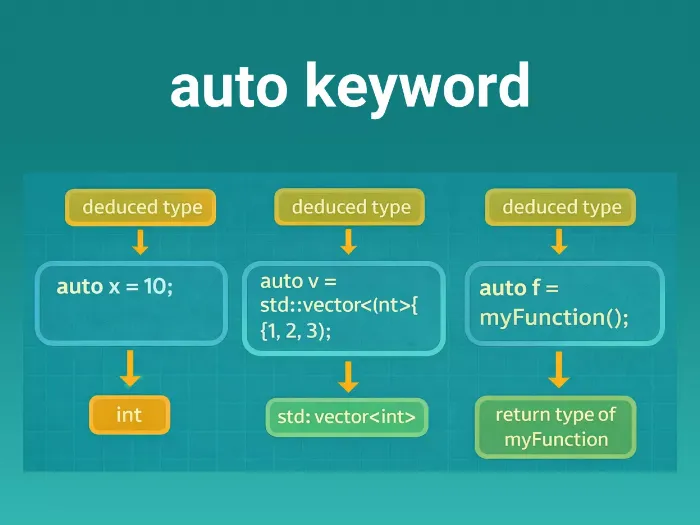
In C (and older C++), you must explicitly declare the type of every variable (e.g., int x, float y).
In modern C++, the auto keyword tells the compiler to automatically deduce the type of a variable based on its initializer.
It is not a dynamic type (like Python). The type is determined statically at compile time, so there is zero performance cost.
Syntax & Usage
1. Basic Deduction
The compiler looks at the right side of the = to figure out the type.
auto x = 10;        // Deduces 'int'
auto y = 3.14f;     // Deduces 'float'
auto z = x + y;     // Deduces 'float' (result of int + float)
2. The "Killer App": Iterators
The main reason auto was introduced is to simplify complex types, especially when using standard libraries or templates.
// Without auto (Verbose & Hard to maintain)
std::vector<SensorData>::iterator it = buffer.begin();

// With auto (Clean & Readable)
auto it = buffer.begin();
3. Range-Based Loops
When iterating over arrays or containers.
int data[] = {1, 2, 3};

// 'val' is deduced as 'int'
for (auto val : data) {
    // ...
}
Types: Value vs. Reference
| Declaration | Deduction Rule | Usage |
|---|---|---|
auto x = val; | Copies the value. | Standard primitives (int). |
auto& x = val; | Creates a reference (alias). | Modifying elements in a loop. |
const auto& x = val; | Read-only reference. | Efficiently reading large structs. |
Relevance in Embedded/Firmware
1. Refactoring Safety
If you change a function's return type (e.g., from uint16_t to uint32_t to handle a larger timer), code using auto updates automatically.
// If get_timer() changes type, 't' adapts automatically.
auto t = get_timer();
2. Complex Template Types
In embedded C++, we often use templates for buffers or hardware registers. The types can get messy (RingBuffer<Packet, 64>::Handle). auto makes the code readable without hiding the fact that it is a specific type.
3. Lambda Functions
auto is the only way to store a lambda function variable, as lambda types are compiler-generated and unnamed.
auto callback = [](int e) { log_error(e); };Common Pitfalls (Practical Tips)
| Pitfall | Details |
|---|---|
| ❌ Uninitialized | auto x; is illegal. You must initialize it so the compiler can deduce the type. |
| ❌ Reference Dropping |
Fix: Use |
| ✅ Usage Rule | Use auto for complex types (iterators) or where the type is obvious (auto x = cast<int>(y)). Avoid it for simple types (auto i = 0) where explicit int is clearer. |
Concept understood? Let's apply and learn for real