Move Semantics (Ownership Transfer)
In C++, copying an object (Deep Copy) is expensive—it involves allocating new memory and copying data byte-by-byte.
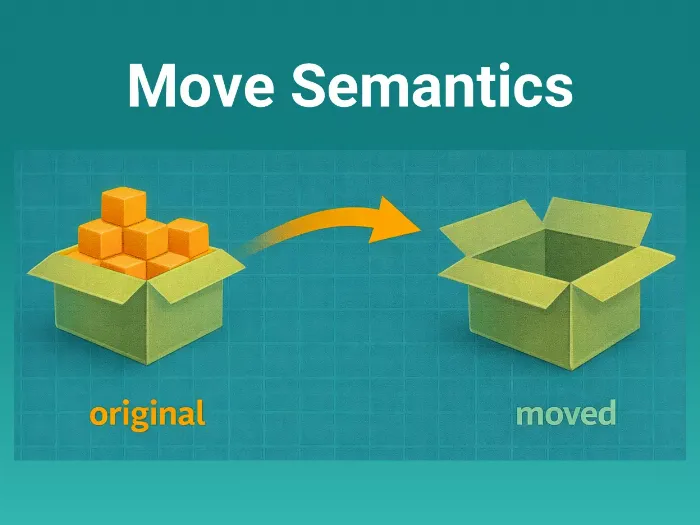
Move Semantics (introduced in C++11) allows you to transfer ownership of resources (like memory pointers or file handles) from one object to another without copying the actual data.
Think of it as "Stealing" the resources.
- Copy: I photocopy your notes. Now we both have sheets of paper. (Slow)
- Move: I take the notes from your hand. I have them, you have nothing. (Fast).
Syntax & Usage
1. R-value References (&&)
To distinguish between "Copyable" and "Movable" objects, C++ uses &&.
- L-value (
Type&): A persistent variable (x). You Copy it. - R-value (
Type&&): A temporary object (Type()) or explicitly moved object. You Move it.
2. Move Constructor & Assignment
Instead of allocating new RAM, we just copy the pointer and set the old pointer to nullptr.
class Buffer {
    uint8_t* ptr;
public:
    // Move Constructor
    Buffer(Buffer&& other) noexcept {
        this->ptr = other.ptr;  // 1. Steal the pointer
        other.ptr = nullptr;    // 2. Nullify the source (Prevent double-free)
    }

    // Move Assignment
    Buffer& operator=(Buffer&& other) noexcept {
        if (this != &other) {
            delete[] ptr;           // Free my current memory
            this->ptr = other.ptr;  // Steal
            other.ptr = nullptr;    // Nullify
        }
        return *this;
    }
};
3. std::move
Forces a move on a named variable.
Buffer b1(100);
Buffer b2 = std::move(b1); // b2 owns the memory. b1 is now empty.
Copy vs. Move Visualization
| Feature | Copy (const Type&) | Move (Type&&) |
|---|---|---|
| Operation | Duplicate Data (Deep Copy). | Transfer Pointer (Shallow Copy). |
| Old Object | Remains valid and unchanged. | Valid but Empty (gutted). |
| Cost | High (alloc + memcpy). | Near Zero (pointer assignment). |
| Hardware | Duplicates logic (Bad for drivers). | Transfers ownership (Good for drivers). |
Relevance in Embedded/Firmware
1. High-Performance Returns
In C, to avoid copying a large struct, we pass pointers: void get_data(BigStruct* out).
In C++, Move Semantics allow you to return by value efficiently.
// Returns a heavy object (e.g., 1KB buffer)
Packet receive_packet() {
    Packet p;
    // ... fill p ...
    return p; // Compiler automatically Moves this out. Zero overhead.
}
2. Driver Ownership (std::unique_ptr)
Hardware drivers (UART, SPI) are "non-copyable" (you can't clone a physical peripheral). However, you often want to move a driver around (e.g., create it in init() and pass it to a Manager class).
Move semantics allow this safe transfer of ownership without cloning.
3. Container Performance
If you have a std::vector<String>, resizing the vector requires moving all elements to a new memory block.
- Without Move: Every string is malloc'd and copied. (Slow, heap fragmentation).
- With Move: Only pointers are swapped. (Fast, no heap churn).
Common Pitfalls (Practical Tips)
| Pitfall | Details |
|---|---|
| ❌ Use After Move | Accessing an object after moving from it is undefined logic (usually crashes).
|
❌ std::move doesn't move | std::move(x) generates no code. It effectively just casts x to x&&, telling the compiler "Please try to use the Move Constructor." If you didn't write a Move Constructor, it silently falls back to Copy. |
❌ noexcept | Always mark move constructors as noexcept. If a move can throw an exception, standard containers (like vector) will refuse to use it and will Copy instead. |
| ✅ Rule of Five | If you write a custom Destructor, you typically need: Copy Ctor, Copy Assign, Move Ctor, Move Assign. |
Concept understood? Let's apply and learn for real