
The "this" Pointer (Self-Reference)
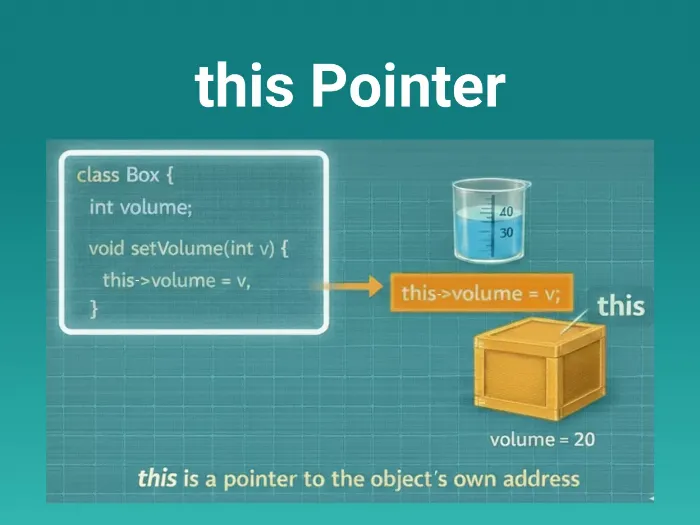
Inside every non-static member function, C++ provides a hidden pointer named this.
It points to the address of the object that called the function.
Think of it as the word "Me" or "My" in English.
If Alice says "My pocket", she refers to Alice's pocket.
If Bob says "My pocket", he refers to Bob's pocket.
The code (the sentence) is the same, but the context (
this) changes depending on who speaks.
Syntax & Usage
A. Resolving Name Conflicts
The most common use is when a function argument has the same name as a class member variable. this-> explicitly tells the compiler "use the member variable, not the local argument."
class Servo {
    int pos; // Member variable
public:
    // Argument 'pos' shadows member 'pos'
    void setPos(int pos) {
        // pos = pos;      // WRONG: Assigns argument to itself.
        this->pos = pos;   // RIGHT: "My pos" = argument "pos".
    }
};
B. Method Chaining (Fluent Interfaces)
You can return *this (the object itself) to chain function calls on a single line. This is common in configuration patterns (Builders).
class LCD {
public:
    LCD& clear() {
        /* clear screen */
        return *this; // Return reference to myself
    }
    LCD& setCursor(int x, int y) {
        /* move cursor */
        return *this;
    }
    LCD& print(const char* s) {
        /* print text */
        return *this;
    }
};

int main() {
    LCD screen;
    // Chaining calls:
    screen.clear().setCursor(0, 1).print("Ready");
}
Under the Hood (The Hidden Argument)
How does one function code work for 100 different objects?
The compiler secretly modifies your function. It adds a hidden first argument: the pointer to the object.
Your C++ Code | What the Compiler Actually Generates (C-Style) |
|---|---|
|
|
|
|
Note: This is why Static Functions do not have
this. They are not passed this hidden argument, so they don't know which object to touch.
Relevance in Embedded/Firmware
A. RTOS Tasks & C-Style Callbacks
Most RTOSs (FreeRTOS, ThreadX) and Hardware Drivers use C APIs. They allow you to pass a void* context parameter to callbacks.
We pass this so the static C callback knows which C++ object to restore.
class Button {
public:
    void onClick() { printf("Clicked!\n"); }

    // Static wrapper compatible with C-style callback
    static void callback_wrapper(void* context) {
        // 1. Cast 'void*' back to 'Button*'
        Button* self = static_cast<Button*>(context);

        // 2. Call the actual member function using the restored pointer
        self->onClick();
    }
};

// Registering interrupt: pass 'this' as the context
attachInterrupt(PIN_5, Button::callback_wrapper, this);
B. Self-Assignment Check
In assignment operators (operator=), you must check if the user is trying to assign an object to itself (obj = obj;). If you don't check this, you might delete your own data before copying it (Disaster).
Buffer& operator=(const Buffer& other) {
    if (this == &other) { // Am I copying myself?
        return *this;     // Do nothing.
    }
    // Proceed with copy...
}
Common Pitfalls (The Danger Zone)
Pitfall | Details |
|---|---|
❌ | Is it legal? Yes. Is it dangerous? Extremely. If you write delete this;, the object destroys itself. Accessing any member variable afterwards causes a crash. Used rarely (e.g., in "Fire and Forget" tasks). |
❌ Using in Static | Static functions belong to the class, not an instance. Trying to use this inside a static method causes a compile error: "invalid use of member in static member function". |
❌ Capture in Lambdas | In C++11 Lambdas, using [=] captures variables by value, but it captures this as a pointer. If the object dies but the lambda runs later (async callback), accessing members via the captured this will crash (Use After Free). |
Summary Checklist
Use
this->variableto fix shadowing names.Return
*thisto enable method chaining (obj.func1().func2()).Pass
thisasvoid* contextwhen integrating with C libraries or RTOS tasks.Never access
thisinside astaticfunction.
Concept understood? Let's apply and learn for real