
References (The Safer Pointer)
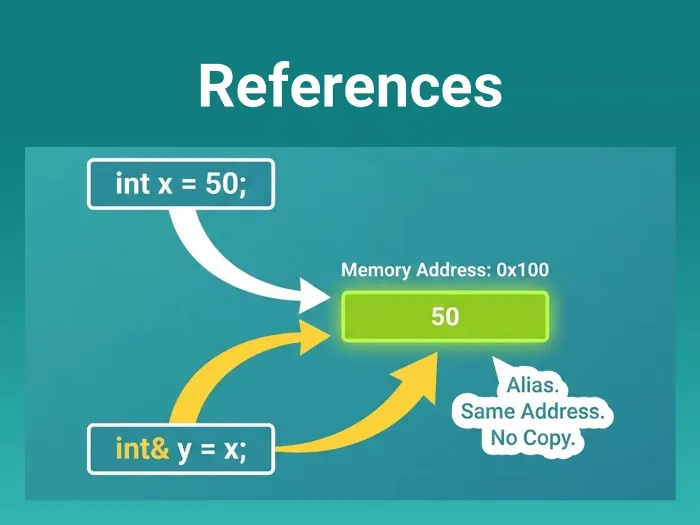
A Reference in C++ is an alias (an alternative name) for an existing variable.
Unlike a pointer, which holds a memory address and can be NULL, a reference must be initialized to a valid object and cannot be changed to refer to a different object later.
Think of it as a const pointer that is automatically dereferenced for you.
Syntax & Usage
1. Basic Declaration
int x = 10;
int &ref = x;  // 'ref' is now an alias for 'x'

ref = 20;      // Modifies 'x' directly
// x is now 20
2. Pass-by-Reference (Function Parameters)
In C, to modify a variable inside a function, you pass a pointer. In C++, you pass a reference.
| C Style (Pointers) | C++ Style (References) |
|---|---|
| |
Call: update(&x); | Call: update(x); |
3. const Reference (Read-Only Access)
Used to pass large objects (like structs or buffers) efficiently without copying them and without allowing modification.
struct SensorData {
    float x, y, z;
    uint32_t timestamp;
};

// Efficient: No copy created, but strictly Read-Only
void processData(const SensorData &data) {
    // data.x = 0;  // ❌ Error: Read-only
    printf("%f", data.x); // ✅ OK
}
Pointer vs. Reference (Crucial for Embedded)
| Feature | Pointer (int*) | Reference (int&) |
|---|---|---|
| Nullability | Can be NULL (needs checking). | Cannot be NULL (always valid). |
| Reassignment | Can point to different addresses. | Bound to one object forever. |
| Memory Address | Has its own address on stack. | Shares address of the target. |
| Syntax | Requires * to access value. | Accessed like a normal variable. |
| Embedded Use | Low-level hardware/buffer access. | High-level APIs and safety. |
Relevance in Embedded/Firmware
1. Efficient Driver APIs
Passing hardware driver objects (like UART or SPI classes) by value copies the entire object, which breaks register mappings. Passing by pointer creates messy syntax (->). References offer the best of both:
// Clean syntax, no copying, no NULL checks needed
void generic_log(UART_Driver &uart, const char *msg) {
    uart.send(msg);
}
2. Operator Overloading
References are mandatory for operator overloading (e.g., operator=, operator[]), which allows you to treat hardware buffers like standard arrays.
3. Range-Based For Loops
When iterating over a container or array without copying elements:
// 'byte' is a reference to the actual array element
for (uint8_t &byte : rx_buffer) {
    byte = 0; // Clear buffer efficiently
}
4. Singleton Access
Returning a reference from a Singleton getInstance() is safer than a pointer because the user knows it will never be null.
Common Pitfalls (Practical Tips)
| Pitfall | Details |
|---|---|
| ❌ Dangling Reference | Returning a reference to a local variable destroys the stack frame, leaving the reference pointing to garbage. |
| ❌ "Null" Reference | While technically impossible, dereferencing a |
| ❌ Reference to Bitfield | You cannot create a reference to a bitfield in a struct because bits don't have unique memory addresses. |
| ✅ Use References for API | Prefer const Type& for input arguments in functions to avoid unnecessary copying of structs. |
| ✅ Use Pointers for Optional | If a parameter is optional (can be NULL), use a pointer. References imply "this must exist." |
Concept understood? Let's apply and learn for real