
Constructors (Automatic Initialization)
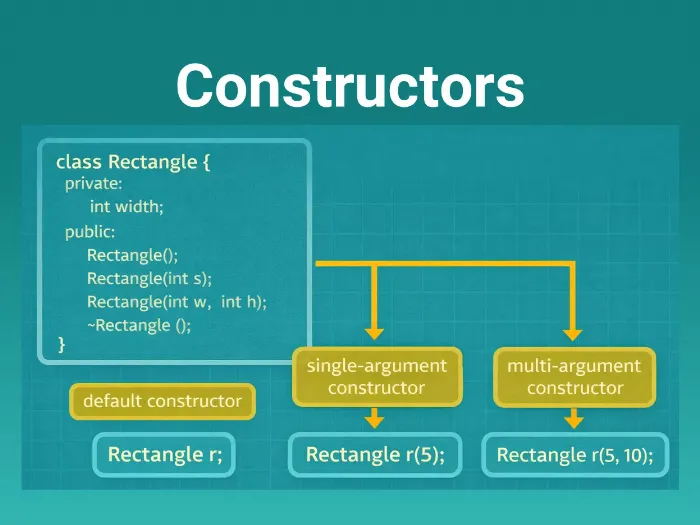
A Constructor is a special member function that runs automatically when an object is created. Its purpose is to guarantee that the object starts in a valid state (e.g., pointers assigned, hardware initialized, invariants checked) before any other code uses it.
It has no return type and shares the same name as the class.
Syntax & Usage
1. Basic & Parameterized Constructors
The most common forms used to initialize variables.
class GPIO {
    int pin;
public:
    // 1. Default Constructor (No args)
    GPIO() { pin = 0; }

    // 2. Parameterized Constructor (With args)
    GPIO(int p) { pin = p; }
};

GPIO led;        // Calls GPIO()
GPIO motor(9);   // Calls GPIO(int)
2. Member Initializer Lists (Crucial for Efficiency)
Initializes variables before the constructor body runs. This is mandatory for const members and References, and avoids "double-writing" variables.
class Sensor {
    const int id;
    int& bus_ref;
public:
    // Syntax: : member(value), member(value)
    Sensor(int i, int& bus) : id(i), bus_ref(bus) {
        // Body is empty; work is already done.
    }
};
3. Advanced Variants (explicit, Copy, delete)
These control how objects are created or copied, preventing dangerous bugs.
explicit: Prevents accidental implicit conversions (e.g., passingintwhere aDriverobject is expected).- Copy Constructor: Defines how to clone an object (crucial for Deep Copies of pointers).
= delete: Disables a constructor (used for Singletons or unique hardware drivers).
class Driver {
    int* buffer;
public:
    // PREVENT implicit conversion from int to Driver
    explicit Driver(int size) { buffer = new int[size]; }

    // CUSTOM Copy Constructor (Deep Copy)
    Driver(const Driver& other) {
        buffer = new int[10];
        memcpy(buffer, other.buffer, 10 * sizeof(int));
    }

    // DISABLE Copying entirely (Common for hardware drivers)
    // Driver(const Driver&) = delete;
};
Initialization vs Assignment Flow
| Feature | Assignment (Inside Body) | Initializer List (: x(10)) |
|---|---|---|
| Mechanism | Variable created (default), then overwritten. | Variable created with value. |
| Performance | Slower (Two steps). | Faster (One step). |
| Constraints | Cannot init const or Reference. | Required for const/Reference. |
Relevance in Embedded/Firmware
1. Impossible-to-Forget Initialization
In C, forgetting UART_Init() crashes the system.
In C++, constructors force you to provide configuration (e.g., Baud Rate) at creation time. The object never exists in an uninitialized state.
2. RAII (Resource Acquisition Is Initialization)
The "Scope Lock" pattern: A constructor acquires a resource (disables interrupts, takes a mutex), and the Destructor releases it.
{
    InterruptLock lock; // Constructor: __disable_irq();
    // Critical Section
} // Destructor: __enable_irq(); automatic at end of scope.
3. Unique Hardware Access
Using = delete on copy constructors ensures you don't have two software objects trying to control the same physical UART peripheral, preventing race conditions.
Common Pitfalls (Practical Tips)
| Pitfall | Details |
|---|---|
| ❌ Heavy Work | Avoid complex hardware delays or checks in constructors for Global/Static objects. They run before main(), which can make the system appear to hang at boot. |
| ❌ Initializer Order | Members are initialized in the order they are declared in the class, NOT the order in the list.
|
| ❌ Implicit Conversion | Without explicit, void func(Driver d) can be called as func(100), silently creating a 100-byte driver. This is confusing and dangerous. |
| ✅ Default Constructor | If you define any constructor, the compiler removes the default (empty) one. You must explicitly add GPIO() = default; if you still need it. |
Concept understood? Let's apply and learn for real