
Static Memory (The Persistent Storage)
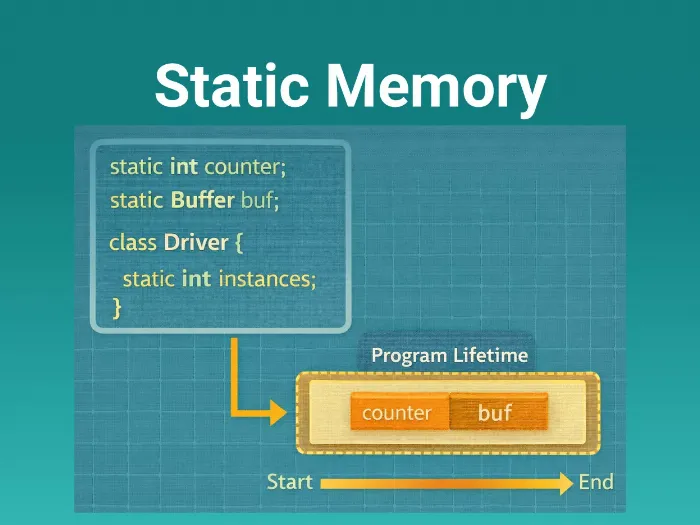
In C++, Static Memory refers to variables that are allocated once when the program starts and persist until the program ends. They are not created/destroyed repeatedly like Stack variables, nor are they manually managed like Heap variables.
The keyword static has two distinct meanings depending on where it is used:
Lifetime: The data survives forever (Persistence).
Visibility: The data is hidden from other files (Internal Linkage) OR shared by all objects of a class (Shared Scope).
The Three Contexts of static
A. Static Local Variables (Function Scope)
Behavior: Preserves value across function calls.
Initialization: Initialized only the first time control passes through the declaration.
Destruction: Destructed when main() exits.
void count_events() {
    // 1. Initialized only ONCE (Thread-safe in C++11+)
    static int counter = 0;

    counter++;
    printf("Events: %d\n", counter);
}
// Call 1 -> "Events: 1"
// Call 2 -> "Events: 2" (It remembers!)
Embedded Use: replacing global variables. If a variable is only used by one function but needs to remember its state (e.g., a filter's previous input), make it
static local. It keeps the global namespace clean.
B. Static Class Members (Class Scope)
Behavior: Shared by all instances of the class. It belongs to the Class, not the Object.
Storage: Stored in a single fixed memory location, regardless of how many objects you create (0, 1, or 100).
class Driver {
public:
    static int active_drivers; // Declaration (Blueprint)

    Driver() { active_drivers++; }
    ~Driver() { active_drivers--; }

    // Static Methods: Can run without an object.
    // Can ONLY access static variables.
    static int getCount() { return active_drivers; }
};

// Definition (Allocation): MUST be in .cpp file (Global Scope)
int Driver::active_drivers = 0;
C. Static Global Variables (File Scope)
Behavior: Limits visibility to this specific file only (Internal Linkage).
Purpose: Encapsulation at the file level. Prevents name collisions with variables in other .cpp files.
// File1.cpp
static int buffer[100]; // Only File1 sees this

// File2.cpp
int buffer[100]; // Totally different variable. No Linker Error.
Note: In modern C++, Anonymous Namespaces (
namespace { ... }) are preferred overstaticfor file-scope hiding, butstaticis still ubiquitous in embedded code.
Memory Layout (Deep Dive)
Static variables live in specific memory segments, handled by the Startup Code (crt0.s) before main() begins.
Segment | Description | Example | Startup Cost |
|---|---|---|---|
| Uninitialized or Zero-initialized statics. |
| Fast. Startup code just |
| Initialized statics (Non-zero). |
| Slower. Startup code must |
| Read-Only statics (Constants). |
| Zero RAM. stays in Flash (ROM). |
Optimization Tip: Prefer Zero-initialization (
= 0). It saves Flash space and reduces boot time compared to Non-Zero initialization.
Advanced Initialization Details
A. The "Static Initialization Order Fiasco"
The order in which global/static variables are initialized across different translation units (.cpp files) is undefined.
If
FileA.cpphasstatic int A = 10;And
FileB.cpphasstatic int B = A + 1;The compiler might initialize
BbeforeA, resulting inB = 0 + 1 = 1(Garbage) instead of11.Fix: Use the Construct On First Use idiom (Lazy Singleton).
B. Modern C++ Features (C++17)
inline static: Solves the annoyance of defining variables in the .cpp file.
class Config {
public:
    // C++17: Memory allocated immediately. No .cpp definition needed.
    inline static int timeout = 1000;
};
constexpr static: Used for compile-time constants.
class Math {
public:
    // Stored in Flash (ROM). No RAM usage.
    static constexpr float PI = 3.14159f;
};
Relevance in Embedded/Firmware
A. Determinism & Safety
Dynamic Memory (malloc/new) is non-deterministic. It can fail (return NULL) or take variable time (heap walking).
Static Memory is allocated by the linker.
Fail-Safe: If you run out of RAM, the Linker fails (Build Error), not the runtime (Crash). You know before you ship.
Timing: Accessing static memory is O(1) and cache-friendly.
B. Placement New (Static Class Objects)
How to use C++ Objects (Constructors) without the Heap?
You reserve a static buffer and build the object there.
#include <new>

// 1. Reserve Static RAM (BSS)
alignas(UART) uint8_t uart_memory[sizeof(UART)];

void system_init() {
    // 2. Construct object in static RAM
    UART* ptr = new (uart_memory) UART(9600);

    // Object lives forever. No delete needed (unless shutting down).
}
C. Thread-Safe Initialization ("Magic Statics")
Since C++11, static local variable initialization is guaranteed to be thread-safe.
If two threads call getInstance() at the same time, the compiler inserts hidden locks (mutexes) to ensure the object is constructed exactly once.
Warning: In very low-level embedded (No OS, simple startup), verify your compiler supports this or if flags like
-fno-threadsafe-staticsare enabled.
Common Pitfalls & Checklist
Pitfall | Explanation | Prevention |
|---|---|---|
Linker Error (Undefined Reference) | You declared static int x; in the class but didn't define it in .cpp. | Add int Class::x = 0; in source or use inline static (C++17). |
Concurrency / Race Conditions | Static variables are shared globals. If an ISR and Main Loop both write to it, data corruption occurs. | Always use volatile if shared with ISR, and wrap in Critical Sections (disable interrupts). |
Large | Initializing large arrays (static int arr[1000] = {1, 2...}) copies data from Flash to RAM at boot. | Mark large lookup tables as const or constexpr so they stay in Flash (.rodata). |
Hidden Dependencies | One static variable depends on another static variable in a different file. | Refactor to use local statics (Functions returning values) to control order. |
Concept understood? Let's apply and learn for real